
The Complete Guide to Sublimation printed patches UK in 2026
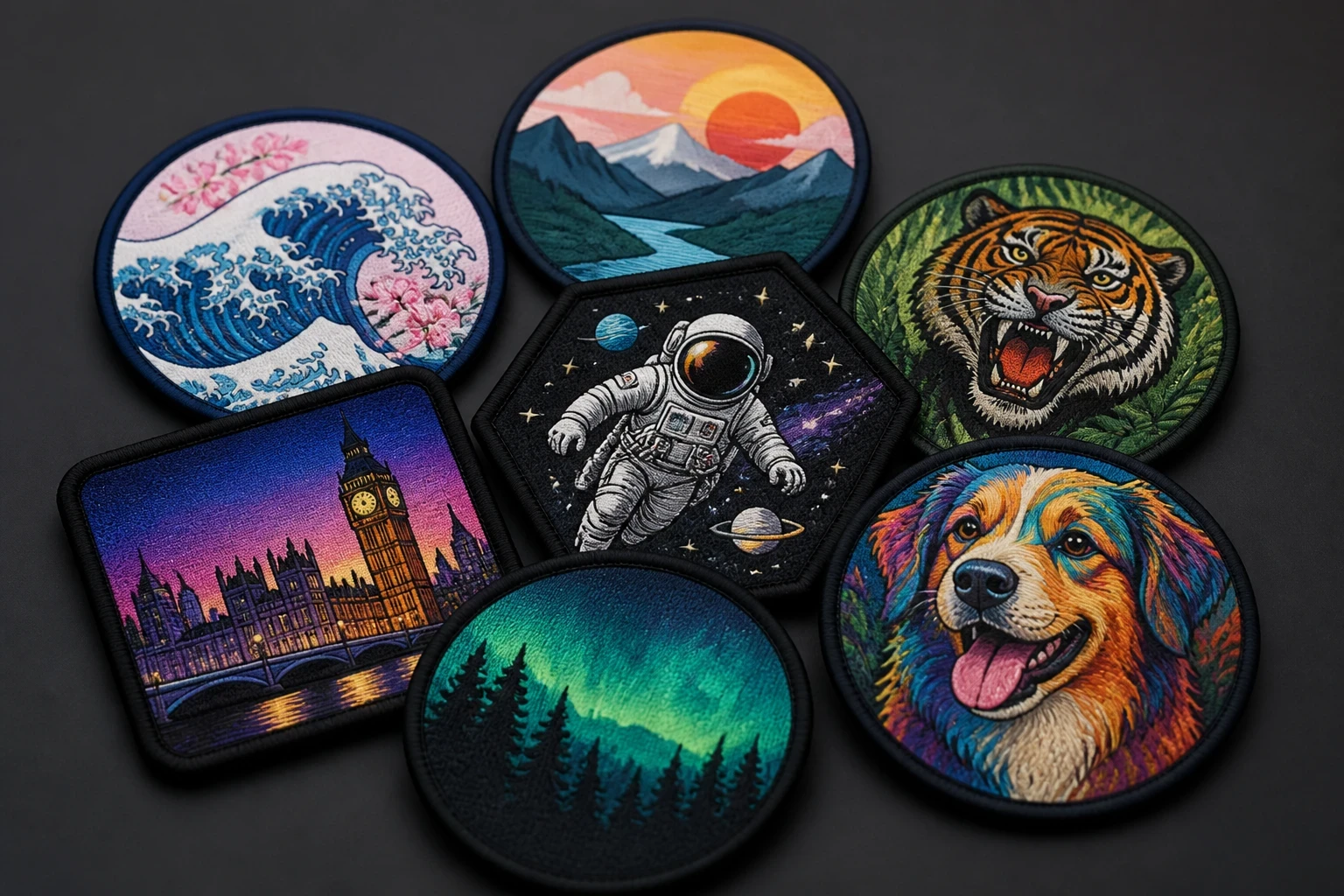
Sublimation printed patches UK are fabric patches made by transferring coloured artwork into a suitable polyester face, producing a flat printed finish rather than raised thread. They suit detailed logos, gradients, photographs and small text. The Customized Patches has a 5-piece minimum per design, provides a free digital mockup usually within 12 hours, and produces only after approval.
Key takeaways
- Sublimation printed patches UK use transferred colour on a suitable fabric face, so the result is flat and suited to gradients, photographs and fine artwork.
- They are not automatically the best choice for every garment: nylon shells, heat-sensitive fabrics, heavy-duty workwear and high-friction areas need a backing and attachment method chosen carefully.
- The Customized Patches accepts a 5-piece minimum per design and usually sends a free digital mockup within 12 hours.
- Production starts only after artwork, size, quantity, shape, edge and backing have been approved.
Sublimation printed patches UK are flat fabric patches made by transferring artwork into a suitable polyester face. They are often chosen for gradients, photographic images, fine linework and small quantities where raised thread is not required. The Customized Patches supplies UK customers with a 5-piece minimum per design, a free digital mockup usually within 12 hours, and production only after approval.
The short version is this: printed is flatter; that is the point. If your football club needs a sunset graphic, a hospitality team needs a detailed crest, or a small brand wants a full-colour badge without simplifying its logo, sublimation can be a sensible route. It is not a magic finish for every garment, though, and the fabric, backing and attachment method still matter.
What are sublimation printed patches UK?
Sublimation printing uses heat to transfer dye into a compatible synthetic fabric, usually a polyester-based face. The artwork becomes part of the printed surface rather than sitting as a thick layer of thread or vinyl. The exact construction varies by supplier, so a quote should confirm the face fabric, edge finish, backing and intended use rather than relying on the word sublimation alone.
This construction gives the patch a clean, low-profile feel. You can see colour changes and fine artwork without the ridges created by dense embroidery. That is useful on shirts, lightweight jackets, caps, bags and panels where a bulky badge would look out of place. It also means the patch will not have the tactile, raised character of a merrowed embroidered crest.
A sublimation printed patch should not be confused with a printed transfer or a loose piece of fabric cut from a roll. A proper patch still needs a defined shape, a finished edge and a backing suited to the garment. The quote should state whether the border is printed, laser-cut, merrowed or otherwise finished, because that changes both appearance and durability.
Why choose sublimation printed patches UK in 2026?
The strongest reason is artwork. A photograph of a mountain, a club mascot with shading, a sponsor mark with a gradient or a brand illustration with many colour changes can be difficult to reproduce with thread. Sublimation keeps those transitions visible without turning the design into a block of simplified shapes.
They also work well for teams and businesses that need a small run. The Customized Patches has a 5-piece minimum per design, which is useful for a trial batch, a small staff group, a limited club project or a handful of garments. The minimum applies per design, so five versions of one badge are not normally the same as one each of five unrelated designs.
- Flat finish for garments where a low-profile badge is preferable.
- Good scope for gradients, shading, photographs and detailed illustrations.
- Useful for football clubs, esports teams, hospitality uniforms, school groups and small brands.
- Suitable for designs that would require extensive thread changes in embroidery.
- A practical option when the same artwork needs to be reproduced across a short run.
There are trade-offs. A printed patch can show detail that embroidery cannot, but it does not provide the raised texture people expect from a traditional crest. Colour can also look different on screen, on a digital proof and on the finished fabric. That is why an approved mockup and a clear production specification are more useful than choosing from a product name alone.
Sublimation printed patches versus embroidered and woven patches
Printed, embroidered and woven patches are not simply three names for the same thing. They are different ways of building the visible face. Embroidery uses stitches, woven patches use a tightly woven surface for fine lettering and printed patches apply colour to a suitable face fabric.
For a traditional football club badge, a merrowed embroidered edge and raised thread may be exactly right. For a photographic motorcycle scene, printed colour may reproduce the image more faithfully. A detailed small label may suit woven patches better, while a rubberised outdoor badge may point towards PVC patches. The correct choice follows the artwork and garment, not a general claim that one method is best.
| Patch type | Surface and appearance | Best suited to | Main limitation | Typical UK use |
|---|---|---|---|---|
| Sublimation printed | Flat fabric face with transferred colour | Photographs, gradients, illustrations and detailed colour work | Less texture than embroidery; care and backing still affect service life | Football graphics, hospitality polos, brand artwork and event patches |
| Embroidered | Raised thread with visible stitch texture | Traditional crests, bold logos and uniform badges | Very fine detail and gradients may need simplifying | Club badges, school blazers, cadet units and workwear |
| Woven | Flat woven threads with a clean, slightly textured face | Small lettering, linework and compact logos | Photographic shading and soft gradients are less natural | Labels, fashion patches, caps and detailed brand marks |
| PVC | Moulded rubber-like raised or recessed surface | Outdoor, practical and strongly graphic designs | Less suitable for photographic images and soft tonal artwork | Outdoor clothing, tactical equipment and bags |
| Leather | Natural or synthetic leather face with stamped or printed detail | Heritage, premium and understated branding | Fine full-colour artwork is not the main strength | Biker jackets, workwear, bags and lifestyle brands |
The difference between printed patches and embroidered patches becomes clearer if you handle both. Printed is flatter and usually carries more visual information. Embroidered has physical depth and a familiar uniform quality. Neither description is a defect; they answer different design problems.
For a classic badge with a strong border, compare embroidered patches and 3D embroidered patches. For a soft, textured sportswear panel, chenille patches may be a better fit. If the badge is intended for a biker vest, look at biker and motorcycle club patches before choosing a flat printed finish.
Artwork requirements for a clean printed patch
Start with the clearest artwork available. A vector PDF, SVG, AI or high-resolution PNG is helpful, but a low-quality image is not automatically unusable. The production team may be able to redraw or adjust it, although that should be discussed before the order is confirmed. Send the original brand colours and explain which details must remain exact.
Small text and fine lines
Small text is one of the most common sources of disappointment. A phrase that reads comfortably on a laptop can become difficult to read on a 2-inch patch. Thin outlines can also soften at the finished size. If wording matters, choose a size that gives the letters room, simplify the copy or ask for a mockup at actual dimensions.
Gradients, photographs and colour
Sublimation is well suited to gradual colour changes, but a screen uses light while a fabric patch uses a physical surface. Fluorescent shades, metallic effects and exact colour matching may need special discussion. A mockup is a visual guide, not a guarantee that every monitor will display the final colour identically.
Avoid placing important details right against the edge. A border gives the eye a clean stopping point and allows the finished shape to look intentional. For more preparation advice, see How to Design Artwork for printed patches That Production-Ready and the guide to printed patches sizing and backing options.
Not sure whether thread, woven detail or ink will hold your logo best? Send the artwork and garment details for a free digital mockup, usually within 12 hours, so you can compare the intended finish before production.
GET A FREE MOCKUP- Provide the intended patch width and height in inches, not only a percentage of the garment.
- Identify the patch orientation and whether the artwork must be read from a particular angle.
- Keep important text away from curved corners and the outer edge.
- State if a white underbase, border or background is part of the design.
- Tell the manufacturer if the patch will be washed frequently, exposed to rain or handled heavily.
Choosing size, shape, edge and backing
Size should be based on the available garment area and the amount of information in the artwork. A simple one-colour chest badge can work at a smaller size than a crest containing a sponsor name, date and detailed mascot. Measure the panel rather than guessing from a product photograph, especially on a school blazer, narrow sleeve or fitted polo.
Common shapes include circles, shields, rectangles, arches and custom outlines. A custom outline can follow a mascot or logo, but it may need a clear border to avoid a ragged-looking perimeter. A merrowed crest edge gives a traditional appearance, while a clean cut edge supports a more modern flat graphic. The chosen edge should be shown on the mockup.
Backing choices
Sew-on is usually the most dependable option for garments that will be worn and washed repeatedly, provided the patch is stitched properly. Iron-on is convenient, but the adhesive and application temperature need to suit the garment. An iron-on patch that looks fine on day one can peel after a dryer cycle if the fabric, heat or washing routine is wrong.
Velcro is useful for removable name panels, tactical clothing, event uniforms and equipment that needs different badges at different times. It adds thickness and requires the garment to have a matching hook or loop panel. Do not specify Velcro simply because it sounds flexible; check the panel dimensions and which side is required.
| Backing | Good fit | Points to check |
|---|---|---|
| Sew-on | Blazers, jackets, polos, bags and regular-use uniforms | Allow time for stitching and check the edge can be sewn through |
| Iron-on | Suitable cotton or blended garments with a compatible finish | Heat, pressure, washing and dryer instructions; avoid assuming it suits nylon |
| Velcro | Removable patches, panels and changing staff or team identifiers | Hook or loop side, panel size, added thickness and secure stitching |
| Adhesive or temporary application | Short-term displays or controlled promotional use | Adhesive life, moisture, friction and whether a permanent method is needed |
Nylon shells deserve particular care. A football rain jacket, outdoor coat or lightweight windbreaker can react badly to high heat, and its surface may not give an iron-on adhesive a reliable bond. For these garments, ask about sew-on or a suitable Velcro arrangement. A wool coaches jacket, school blazer or padded coat may also need the patch sewn rather than heat applied.
Where sublimation printed patches work best
A football club may use them for a tournament graphic, a goalkeeper design or a sponsor panel with several colour transitions. A hospitality business may want a detailed food illustration on a polo without the stiffness of heavy embroidery. A school or cadet unit may prefer a conventional embroidered badge for daily uniform use, while a special event patch can use a full-colour printed design.
They can also suit small brands testing a new identity. Five patches per design is enough to check the visual result on packaging, staff clothing or a small launch run, although the right quantity depends on the project. For brand applications, compare printed work with leather patches and woven patches if the desired impression is more tactile or understated.
- Football and rugby clubs needing detailed tournament or season artwork.
- Esports teams using illustrated mascots, gradients and strong screen-led graphics.
- Hospitality polos carrying food, drink or venue artwork with several colours.
- Small businesses producing a short branded uniform run.
- Events, festivals and clubs creating commemorative patches.
- Bags, caps and jackets where a flat printed face suits the product.
They may be less suitable for a high-abrasion work jacket, a patch that must remain highly raised, or a traditional military-style crest where stitch texture is part of the identity. Printed artwork can also be the wrong choice if the design relies on metallic thread, large solid stitch areas or a tactile chenille surface. A short conversation before quoting can prevent an expensive mismatch.
Care, washing and realistic durability
Durability belongs to the whole patch-and-garment system. The face, edge, backing, sewing, washing temperature, detergent, dryer use and rubbing against equipment all affect the result. A patch on a rarely washed display jacket has a different working life from one on a football kit washed after every match.
Follow the care advice supplied for the final specification. As a general precaution, turn garments inside out, use a suitable temperature and avoid unnecessary tumble drying. Do not drag a hot iron directly across the printed face. If the patch is sewn on, check the thread and perimeter after washing rather than assuming the backing alone is carrying the load.
Iron-on that peels after a dryer cycle is a familiar failure, particularly where application heat was uneven or the garment was not suitable. Nylon shells can distort under heat, and rough bag straps can wear the edge. If the garment is exposed to rain, chemicals, repeated abrasion or industrial laundering, say so at quotation stage rather than treating it as ordinary casual clothing.
How much do sublimation printed patches cost in the UK?
There is no responsible single price without the specification. Size, quantity, shape, artwork preparation, border, backing, packaging and delivery all affect a quote. Five small sew-on patches with a simple design are a different job from a run of large Velcro badges with a custom outline and complex artwork.
Quantity can change the unit cost, but do not order more than you can use just to chase a lower figure. A small club may value five approved samples more than a box of unused patches. A growing clothing brand may need to price storage, packaging and repeat availability as well as the initial manufacture.
| Quote detail | Why it affects the result |
|---|---|
| Finished width and height in inches | Controls detail, proportion, material use and placement |
| Number of patches per design | Affects setup, production planning and unit pricing |
| Artwork complexity | May require checking, redraw work or a decision between print, weave and embroidery |
| Edge and shape | Changes the visible outline and how the patch sits on the garment |
| Backing | Affects application, thickness, removal and suitability for nylon or heat-sensitive fabric |
| Delivery location and deadline | Allows UK-wide shipping and production planning to be quoted accurately |
For a broader pricing discussion, read How Much Do printed patches Cost in the UK?. The useful approach is to request a quote with the complete specification, not to compare an unexplained price for an unnamed patch type.
Ordering from The Customized Patches
The ordering process starts with the design, quantity, size and garment information. Tell us if you are quoting for a football club, cadet unit, hospitality team, school blazer, biker vest or business uniform. A photograph of the application area can help, particularly if the patch needs to sit on a seam, curved panel, existing Velcro area or narrow sleeve.
Name sew-on, iron-on or Velcro on the quote and include the garment type. We will show the intended backing on a free digital mockup, usually within 12 hours, so production matches the application after you approve it.
GET A FREE MOCKUP- Send the artwork and describe the garment or item receiving the patch.
- Confirm the quantity, remembering that the minimum is 5 pieces per design.
- Choose the size in inches, shape, border and preferred backing.
- Review the free digital mockup, usually supplied within 12 hours.
- Check wording, colours, orientation, size, edge and backing.
- Approve the final specification before production begins.
- Arrange delivery to your UK address and apply or sew the patches according to the agreed method.
A mockup is the point at which small errors are cheapest to fix. Check the spelling of a club name, the year on a commemorative badge, the direction of a mascot and whether the backing shown is actually the one needed. The Customized Patches produces only after approval, so the customer remains responsible for confirming the final design and specification.
Lead time depends on the product, quantity, artwork and current production schedule. A free mockup usually arrives within 12 hours, but that is not the same as a promise that finished patches will arrive within 12 hours. If a match, launch, trade show or uniform issue date matters, give the date at the start of the quote and allow time for approval and delivery.
For a step-by-step ordering checklist, see A Step-by-Step Guide to Ordering printed patches. Customers who are still comparing methods can also review the printed patches decision guide before sending the artwork.
Common mistakes UK buyers can avoid
The first mistake is choosing a patch from a screen image without checking its finished size. A badge that looks balanced at 4 inches may lose its text at 2 inches. The second is selecting iron-on for a nylon shell because it is convenient, then discovering that the garment cannot take the required heat.
Another mistake is supplying a screenshot and expecting exact brand reproduction without confirming colours or artwork quality. Screenshots are useful for discussion, but they may be compressed and may display colours differently. Send original files if possible and identify any non-negotiable details.
- Ordering several designs while overlooking the 5-piece minimum per design.
- Approving a mockup without checking the backing or edge finish.
- Using very small text that is technically present but not comfortably readable.
- Failing to mention frequent washing, outdoor exposure or abrasive equipment.
- Assuming a digital mockup is a production date rather than an artwork approval step.
- Comparing prices without comparing size, quantity, edge, backing and delivery.
The fix is simple: provide the full use case, ask specific questions and check the proof at the intended size. Our 10 Questions to Ask Before Ordering printed patches covers the details that commonly get missed on a first order.
Final decision: are sublimation printed patches right for you?
Choose sublimation printed patches if your artwork depends on gradients, photographs, shading or a broad colour range, and you want a flat face. They are also worth considering for a small UK run, provided the garment and backing are compatible. A 5-piece minimum per design gives teams and businesses a manageable starting point.
Choose embroidery if raised texture and a traditional uniform appearance matter more than photographic detail. Choose woven for compact, fine lettering, PVC for a moulded practical finish, chenille for a soft sports surface or leather for a heritage look. The best patch is the one that survives its intended use and represents the design honestly.
The Customized Patches can help compare those routes from the artwork and garment information. Send the design, tell us where it will be used, choose the quantity and review the free digital mockup usually supplied within 12 hours. Nothing is produced until you approve the final specification.
Frequently asked questions
What are sublimation printed patches UK used for?
They are used for flat, full-colour patches featuring gradients, photographs, illustrations, detailed logos and small-run artwork. Common UK applications include football shirts, hospitality polos, club jackets, bags, caps, school projects, events and business uniforms. Suitability still depends on the garment, backing and expected wear.
What is the minimum order for sublimation printed patches?
The Customized Patches has a 5-piece minimum per design. If you need five different designs, confirm how the minimum is applied before ordering, because the requirement is normally counted for each separate artwork design rather than across unrelated designs.
How quickly can I receive a digital mockup?
The Customized Patches usually provides a free digital mockup within 12 hours. This is an artwork approval stage, not a guaranteed finished-delivery time. Production starts only after the design, size, edge, backing and other specifications have been approved.
Are sublimation printed patches better than embroidered patches?
Neither is automatically better. Sublimation printed patches are flatter and usually suit gradients, photographs and detailed colour work. Embroidered patches provide raised thread and a traditional crest appearance. Compare the artwork, garment, washing routine and desired texture before choosing.
Can sublimation printed patches be ironed onto nylon jackets?
Do not assume so. Nylon shells can be sensitive to heat and may not provide a reliable surface for iron-on adhesive. Sew-on or Velcro may be more suitable, depending on the garment and panel. Send a garment photograph or name the fabric when requesting a quote.
How should I order sublimation printed patches from a UK manufacturer?
Send the artwork, quantity, finished size in inches, garment type, intended use, edge preference and backing requirement. Review the free digital mockup, usually within 12 hours, check every detail and approve it. The Customized Patches produces only after approval and can arrange UK-wide shipping.
Ready to produce custom patches for your UK team or brand?
GET A FREE MOCKUP