
Puff embroidery patches UK: A Worked Example for a UK Brand
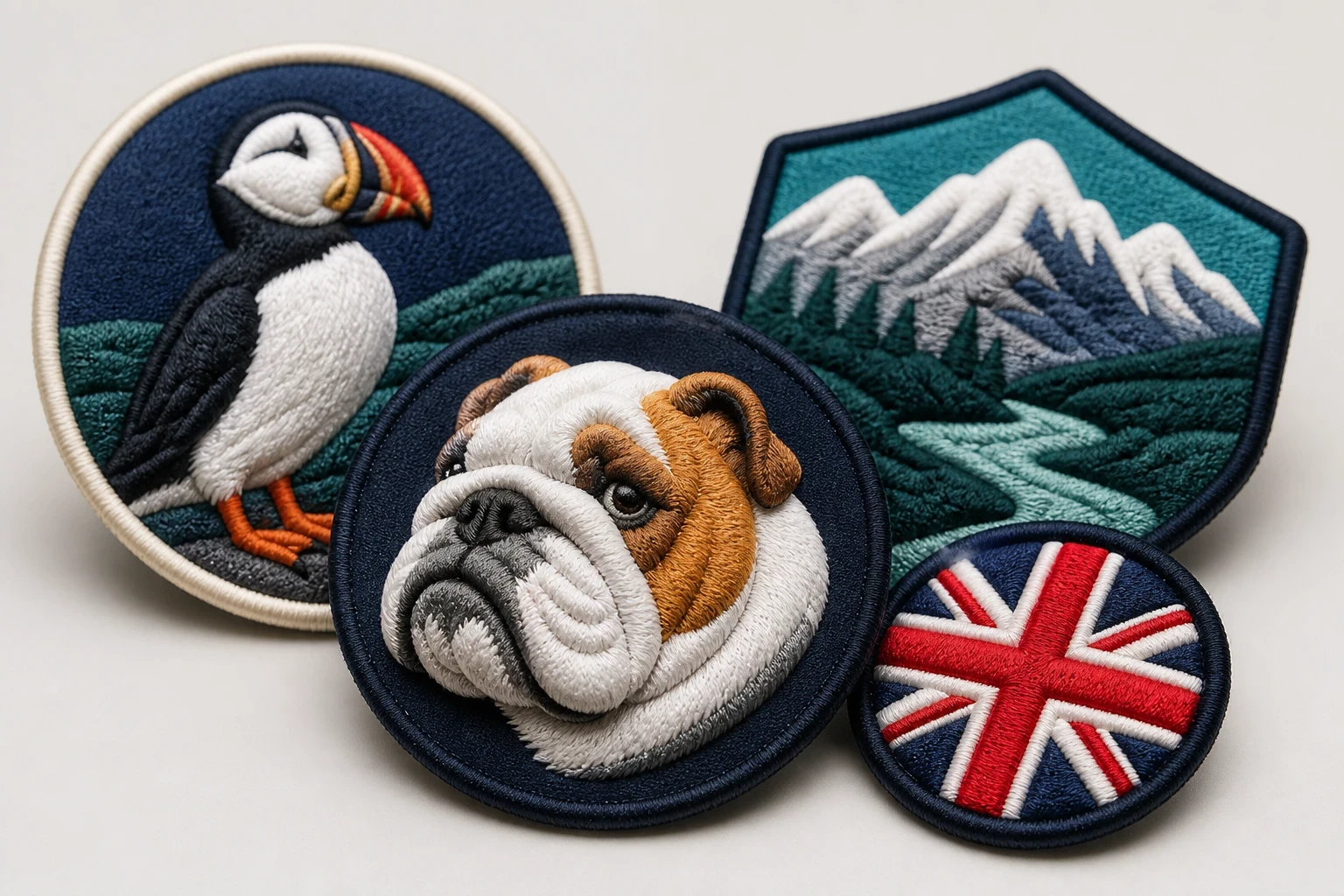
In this illustrative worked example, puff embroidery patches UK add raised foam beneath selected embroidered areas, giving logos and lettering a tactile 3D finish. A UK brand can use them on caps, jackets, hoodies and workwear, provided the artwork has bold shapes and enough spacing. The Customized Patches supplies a free digital mockup usually within 12 hours, with a 5-piece minimum per design.
Key takeaways
- Puff embroidery works best for bold logos, compact lettering and clean shapes rather than tiny detail.
- The UK brand in this worked example used a raised patch because touch and side profile mattered as much as the front image.
- Every design has a 5-piece minimum, and production starts only after the customer approves the artwork and specification.
- The Customized Patches usually sends a free digital mockup within 12 hours so thread, foam, border and backing can be checked before manufacture.
Please note: this is an illustrative worked example, not a report on a real customer. The brand, garments and decisions below are a hypothetical scenario based on common UK patch briefs, written to show the questions worth asking and the choices involved. No customer results, sales figures or reviews are claimed.
Puff embroidery patches UK are embroidered patches with foam beneath selected areas, creating a raised logo or letterform that can be seen and felt. In this UK brand worked example, the raised finish helped a clothing label make a compact chest mark stand out on heavyweight garments without printing directly onto every item.
The Customized Patches planned the design around the garment, the logo and the way the patch would be worn. The brand supplied artwork, reviewed a free digital mockup usually within 12 hours, and approved the specification before anything was produced. The minimum is 5 pieces per design, which made a small launch run practical without forcing a large stock commitment.
The UK brand brief: a raised mark for real garments
The customer was a small UK clothing brand preparing a limited run of heavyweight hoodies, overshirts and caps. Its mark was short, blocky and recognisable, but the ordinary flat embroidered sample looked too quiet against brushed cotton. The brief was not simply to add more colour. The brand wanted a logo with a visible edge, a little height and a finish that felt like part of the garment rather than a thin transfer.
That distinction matters on our team. A patch that looks strong on a computer screen can become muddy at two inches wide, especially if the artwork contains narrow counters, tightly packed lettering or several similar thread colours. It is common to see the same issue on football club crests, cadet unit badges and hospitality polos: the design is technically attractive, but the smallest elements do not survive the chosen size.
The brand therefore sent the logo, the intended patch position and photographs of the garments. It also explained that some patches would be worn on caps and others on jackets. That information affected the recommended size and backing. A cap has a curved crown and limited sewing access; a jacket may have a nylon shell, lining or a Velcro panel.
What the customer wanted the patch to do
- Make the main wordmark visible from a short distance on dark clothing.
- Give the logo a raised surface without raising every tiny detail.
- Keep the patch suitable for caps, hoodies and overshirts.
- Offer a small first order rather than a large bulk run.
- Use an attachment method that matched each garment instead of treating every item the same.
The final decision was to use puff embroidery for the principal lettering and flatter embroidery for the border and supporting details. That mixed construction kept the logo readable while avoiding unnecessary height in areas that needed a clean outline. It also made the patch easier to place on curved garments than a large, heavily raised block.
Why puff embroidery patches UK suited the project
Puff embroidery is made by placing foam under selected stitches. The needlework compresses the foam around the edges, leaving the centre raised. It is particularly useful for bold initials, varsity-style lettering, sports marks and compact brand names where a three-dimensional profile is part of the visual identity.
It is not a solution for every logo. Fine script, detailed landscapes, tiny faces and very small internal gaps usually need a flatter method or a different patch size. If every part of a busy design is raised, the result can lose definition. A good production file identifies which areas should lift and which should remain flat.
| Option | Surface and appearance | Good fit for | Main trade-off |
|---|---|---|---|
| Puff embroidery | Raised foam-backed embroidery with a tactile surface | Bold lettering, initials, streetwear logos, sports marks and caps | Needs simplified artwork and enough spacing around raised areas |
| Flat embroidered patch | Traditional stitched surface with no foam height | Crests, badges, uniforms, detailed borders and general workwear | Less pronounced side profile than puff embroidery |
| Woven patch | Flat, tightly woven surface suited to small lines | Fine lettering, compact symbols and smooth graphic artwork | Does not provide the same raised feel |
| Printed patch | Ink-based image with a flat face | Photographic artwork, gradients and very fine visual detail | Printed is flatter; that is the point, and it will not give the foam effect |
| PVC patch | Moulded rubber-like surface with clear raised levels | Outdoor branding, tactical kit and designs needing wipe-clean handling | Different look and hand-feel from stitched embroidery |
| Chenille patch | Soft, looped yarn with a bold collegiate texture | Varsity lettering, school teams and large simple emblems | Less suitable for tiny details and narrow text |
The brand compared the raised option with flat embroidered patches and 3D embroidered patches. Those terms are sometimes used interchangeably, but the construction and amount of raised work can differ. The important question was not which label sounded most impressive. It was which surface matched the logo, garment and expected handling.
For the logo in this case, puff embroidery offered the right balance. The main letterforms had enough width for foam, the patch would be seen from a normal standing distance, and the raised face supported the brand's heavy garment range. The team kept the finer border elements flat rather than trying to force the full artwork into one height.
Artwork decisions that made the sample work
The first useful change was reducing small detail. The brand's original file contained a narrow inner line and a small secondary word beneath the main mark. At the planned patch size, those elements would have sat too close to the foam edge. They were either widened, moved into the flat embroidered border or removed from the patch version.
This is not a failure of the original logo. A logo designed for a website header does not automatically work as a two-inch patch. Embroidery has stitch direction, thread width, border requirements and physical material to account for. The artwork needs to be judged at the finished size, not only at full screen scale.
The production checks used on the design
- The raised letters were kept broad enough for the foam to hold a clean top surface.
- Small counters inside letters were opened so they would not close with thread compression.
- The outer border was kept flat and clear, giving the edge a defined finish around the raised centre.
- Colours were selected for contrast on both the black hoodie and the lighter overshirt.
- The overall width was checked in inches against the cap front and jacket placement.
- The design was reviewed as a patch, not just as a vector logo.
The mockup showed the proposed patch face, edge and placement. It was a digital representation rather than a promise that every thread would look identical to a screen. That distinction is worth keeping clear. A mockup helps approve the layout, colour direction, approximate scale and raised areas; physical materials and garment texture can still affect the final appearance.
For customers preparing files, the guide How to Design Artwork for puff embroidery patches UK That Production-Ready covers the practical points in more detail. The short version is simple: send clean artwork, identify the important parts of the logo and tell the maker the finished size and garment.
Not sure whether your logo needs puff, flat embroidery or ink? Send the artwork and garment details for a free digital mockup usually within 12 hours, so you can compare the construction before producing.
GET A FREE MOCKUPChoosing size, edge and backing for the garments
Size was considered separately for each placement. The chest patch needed to sit comfortably between seams and not look oversized on the hoodie. The cap version needed enough width for recognition while avoiding excessive curvature. A patch that works at four inches across on a flat overshirt can be awkward on a small cap front.
The brand used a clean embroidered edge around the patch so the raised centre had a defined frame. A merrowed crest-style edge can suit traditional club badges, but a shaped embroidered border often fits a modern clothing label better. The choice depends on the outline, corner shape and how much visual weight the customer wants around the logo.
| Garment or use | Points checked | Backing discussion | Practical caution |
|---|---|---|---|
| Heavyweight hoodie | Chest area, fabric weight and wash routine | Sew-on or a suitable heat-applied option, depending on the garment and use | Check the fabric and care instructions before relying on iron-on alone |
| Nylon shell jacket | Heat sensitivity, lining and slippery outer fabric | Sew-on or hook-and-loop may be more suitable than direct heat application | A hot application can mark or distort some nylon materials |
| Cap | Curved crown, front panel width and access for stitching | Sew-on or an appropriate adhesive solution may be discussed | A large rigid patch may not sit naturally over the curve |
| Velcro panel | Panel dimensions and hook-and-loop orientation | Hook-and-loop backing | Confirm whether the patch must be removable and which side is needed |
| Wool coaches jacket | Nap, seam position and how the patch edge sits | Sew-on is often considered for a lasting attachment | Test placement so stitching does not interfere with the lining |
Backing is not an afterthought. Typical enquiries cover patches for biker vests, school blazers and team jackets where the wrong attachment would have caused trouble. An iron-on patch can be convenient, but it may peel after a dryer cycle or fail to bond properly to a coated nylon shell. Sew-on is slower to fit but gives the customer a different level of control.
If the garment needs removable identification, hook-and-loop should be specified at quote stage. Do not order a standard sew-on patch and expect it to behave like a Velcro badge. The backing changes the thickness, edge and application method. The 3D embroidered patches Sizing and Backing Options Explained guide is useful for comparing these choices.
The approval process before production
The ordering process started with the artwork, quantity and garment information. The customer requested a small first run, so the 5-piece minimum per design was relevant from the start. This allowed the brand to test the patch on its own clothing range without ordering hundreds of units before it had checked the look and application.
- The customer sent the logo and explained the intended garments.
- The production team checked whether the raised areas had enough width and spacing.
- A recommended patch size, edge and backing were discussed for each use.
- A free digital mockup was prepared, usually within 12 hours.
- The customer checked the wording, colours, approximate scale, raised sections and backing.
- The quantity and UK delivery details were confirmed.
- Production began only after the customer approved the final mockup and specification.
That approval point protects both sides. If the customer spots a spelling issue, incorrect thread colour or unsuitable backing, it can be changed before manufacture. The Customized Patches produces only after approval; sending artwork does not mean an order is automatically put into production.
The brand also kept its cap and jacket versions as separate specifications rather than assuming one backing suited every item. This is a small administrative step, but it prevents a common problem: receiving a patch that looks right and then finding that it does not sit properly on the garment for which it was ordered.
What the customer checked on the mockup
- The spelling and order of the brand lettering.
- The relative height of the raised sections and flat border.
- The patch width in inches compared with the intended placement.
- The contrast between thread colours and the garment.
- The edge shape, corner treatment and overall silhouette.
- The backing listed for each garment type.
- The quantity of at least 5 pieces for each design.
What worked, and what the brand accepted as a trade-off
The finished approach worked because the brand made the raised lettering the feature instead of trying to give every line the same treatment. The patch had a clear centre, a controlled edge and enough visual weight for heavyweight clothing. It also remained recognisable when viewed quickly, which mattered more than preserving every minor detail in the original digital artwork.
There were trade-offs. Puff embroidery is not the flattest patch option, and the raised face can show compression if a garment is folded tightly or handled roughly. It also needs sensible spacing. Printed is flatter; that is the point. If the design needs a photographic image, a smooth gradient or very small text, printed patches may be a better match.
The brand also accepted that the cap version could not be treated exactly like the overshirt version. Curvature affects how a patch sits and how the top of the embroidery catches light. This is why a garment photograph or sample measurement is useful at quote stage. It gives the production team something more reliable than a logo file alone.
| Project decision | Reason | Trade-off accepted |
|---|---|---|
| Raised main wordmark | Created the tactile identity the brand wanted | Small supporting details had to be simplified |
| Flat embroidered border | Kept the outline clean and controlled | The patch did not have the same height across every area |
| Separate cap and jacket checks | Allowed for curvature and fabric differences | More information was needed before quoting |
| Small first order | Reduced stock risk for the UK launch | The unit price may differ from a larger production run |
| Approval from a digital mockup | Allowed changes before manufacture | The mockup could not replace checking the real garment and care label |
For businesses comparing materials, woven patches can handle certain fine lines more cleanly, while PVC patches suit customers who want a moulded, wipe-clean surface. A traditional club or school may prefer chenille patches for a soft varsity look. These are not inferior or superior choices in every case; they answer different briefs.
Ordering quantities, timing and UK delivery
The brand's first order was planned around the 5-piece minimum per design. That minimum applies to each separate design, so changing the wording, shape, colour layout or backing may create a separate specification. If a club needs two different crests, for example, the quantities should be listed for each crest rather than added together as one design.
Lead time depends on the design, quantity, backing, approval speed and production schedule. A customer with a fixed launch date should provide it with the first enquiry rather than after the mockup is approved. UK-wide shipping can then be discussed alongside the production plan, with enough time allowed for application to the garments.
The free digital mockup is usually supplied within 12 hours, but that is not the same as a 12-hour manufacturing promise. The mockup is the approval stage. Production follows only when the customer has confirmed the artwork and specification. This distinction helps teams plan a realistic route from enquiry to delivered patches.
Name sew-on, iron-on or Velcro on the quote and tell us the garment you are using. We show the proposed backing on a free digital mockup usually within 12 hours, then produce only after you approve the details.
GET A FREE MOCKUPIf you are ordering for a club, brand, team or business, put these details in the first message: patch width in inches, number of designs, quantity per design, garment type, preferred backing, artwork format, thread colours and required delivery date. Clear information reduces back-and-forth and gives the quote a better starting point.
Would this approach suit your project?
Puff embroidery is a sensible choice if your design has bold lettering, a compact emblem or a strong streetwear, sports or varsity character. It is especially useful when the patch needs to be noticed by touch and side profile as well as by colour. It suits hoodies, caps, overshirts, teamwear and selected workwear applications.
It may not be the right route for a highly detailed club crest, a long sentence, a photographic image or a logo that must remain extremely thin and flat. In those situations, compare embroidered patches, printed patches and leather patches before settling on construction. The right answer is the one that preserves the important part of the artwork on the actual garment.
Brands that need a traditional motorcycle-club layout can also review biker and motorcycle club patches, particularly if the project includes large back patches, rocker text or several attachment requirements. A raised centre can work in that setting, but the complete layout, patch size and garment material still need checking.
A practical decision checklist
- Is the main logo bold enough to support foam and thread?
- Will the lettering remain readable at the finished size?
- Does the garment have a curved, coated, stretchy or lined surface?
- Does each design meet the 5-piece minimum?
- Do you need sew-on, iron-on, adhesive or hook-and-loop backing?
- Have you allowed time for mockup approval, production and UK delivery?
- Would a flat, woven, printed, PVC or leather patch better suit the artwork?
- Have you supplied a garment photograph or accurate placement measurement?
The brand in this case did not succeed by adding complexity. It succeeded by matching a simple raised construction to a simple, bold mark, then checking the patch against the garments before production. That is the useful lesson for other UK buyers: start with the wearing conditions, not only the logo file.
How The Customized Patches handles a puff patch enquiry
The Customized Patches works with UK teams, brands, clubs and businesses that need a clear answer before committing to manufacture. A quote is more useful when it explains the patch size, edge, backing, quantity and garment rather than giving a bare figure with no construction details.
The normal route is straightforward: send the design, tell us how many pieces you need, describe the garments and mention any date that matters. We review the practical points, prepare a free digital mockup usually within 12 hours and wait for approval. The 5-piece minimum per design applies, and production starts only after that approval.
For customers across England, Scotland, Wales and Northern Ireland, UK-wide shipping can be included in the delivery discussion. If you already know the patch will go on nylon shells, wool coaches, school blazers, caps or Velcro panels, say so at the beginning. The application detail can change the recommendation.
You can start with the free mockup quote, or read the Puff embroidery patches UK: Everything UK Buyers Need to Know guide before sending artwork. Customers comparing raised and flat finishes may also find Puff embroidery patches UK vs flat embroidered patches: Which Is Right for Your Project? useful.
Frequently asked questions
What are puff embroidery patches UK?
Puff embroidery patches UK are embroidered patches made with foam beneath selected stitched areas. The foam creates a raised, tactile surface, usually on bold lettering, initials or simple logo shapes. They can be made for UK brands, clubs, teams and businesses, subject to artwork, size, backing and garment checks.
What was the main reason the UK brand chose puff embroidery?
The brand wanted its compact logo to have more height and tactile presence on heavyweight hoodies, overshirts and caps. Puff embroidery made the main lettering stand out, while flatter embroidery was retained for the border and supporting details. The choice was based on the logo and garments, not on using a raised finish everywhere.
What is the minimum order for puff embroidery patches?
The minimum is 5 pieces per design. If two patches have different wording, artwork, shape or specification, they may need to be treated as separate designs. It is best to list the quantity for each design when requesting a quote.
How quickly can I see a mockup for puff embroidery patches UK?
The Customized Patches usually provides a free digital mockup within 12 hours. The mockup is for checking the artwork, approximate size, raised areas, colours, edge and backing. It is not a promise of 12-hour manufacture. Production begins only after the customer approves the final specification.
Can puff patches go on nylon jackets or Velcro panels?
They may be suitable, but the backing must match the garment and use. Nylon shells can be sensitive to heat, so sew-on or hook-and-loop may be considered instead of relying on iron-on. A Velcro panel needs hook-and-loop backing in the correct orientation. Send a garment photograph and panel measurements for a more useful recommendation.
Are puff embroidery patches better than flat embroidered patches?
Neither is automatically better. Puff embroidery adds height and works well for bold lettering and simple marks. Flat embroidery is usually more suitable for detailed crests, fine borders and designs that need a traditional stitched surface. The best choice depends on the artwork, finished size, garment and handling conditions.
Ready to produce custom patches for your UK team or brand?
GET A FREE MOCKUP