
Puff embroidery patches UK Checklist: What to Confirm Before You Order
Before ordering puff embroidery patches UK, confirm the finished size, raised areas, thread colours, lettering, border, backing, garment, quantity and delivery date. The Customized Patches offers a free digital mockup usually within 12 hours, produces only after approval, and accepts a 5-piece minimum per design.
Key takeaways
- Puff embroidery needs a simple design with enough space around raised lettering and shapes.
- Confirm the finished size, backing and garment before approving a quote.
- The Customized Patches has a 5-piece minimum per design and sends a free digital mockup usually within 12 hours.
- Production begins only after you approve the mockup, so check spelling, colours, placement and quantity carefully.
Puff embroidery patches UK orders need a little more checking than flat embroidered patches because the raised foam changes how lettering, gaps and fine details will read. Before you order, confirm the finished size, raised areas, thread colours, border, backing, garment, quantity and delivery date.
The Customized Patches makes these patches for United Kingdom football clubs, cadet units, hospitality teams, biker groups, schools and growing brands. You can request a free digital mockup, usually within 12 hours, and production starts only after you approve it. The minimum is 5 pieces per design.
What makes puff embroidery different?
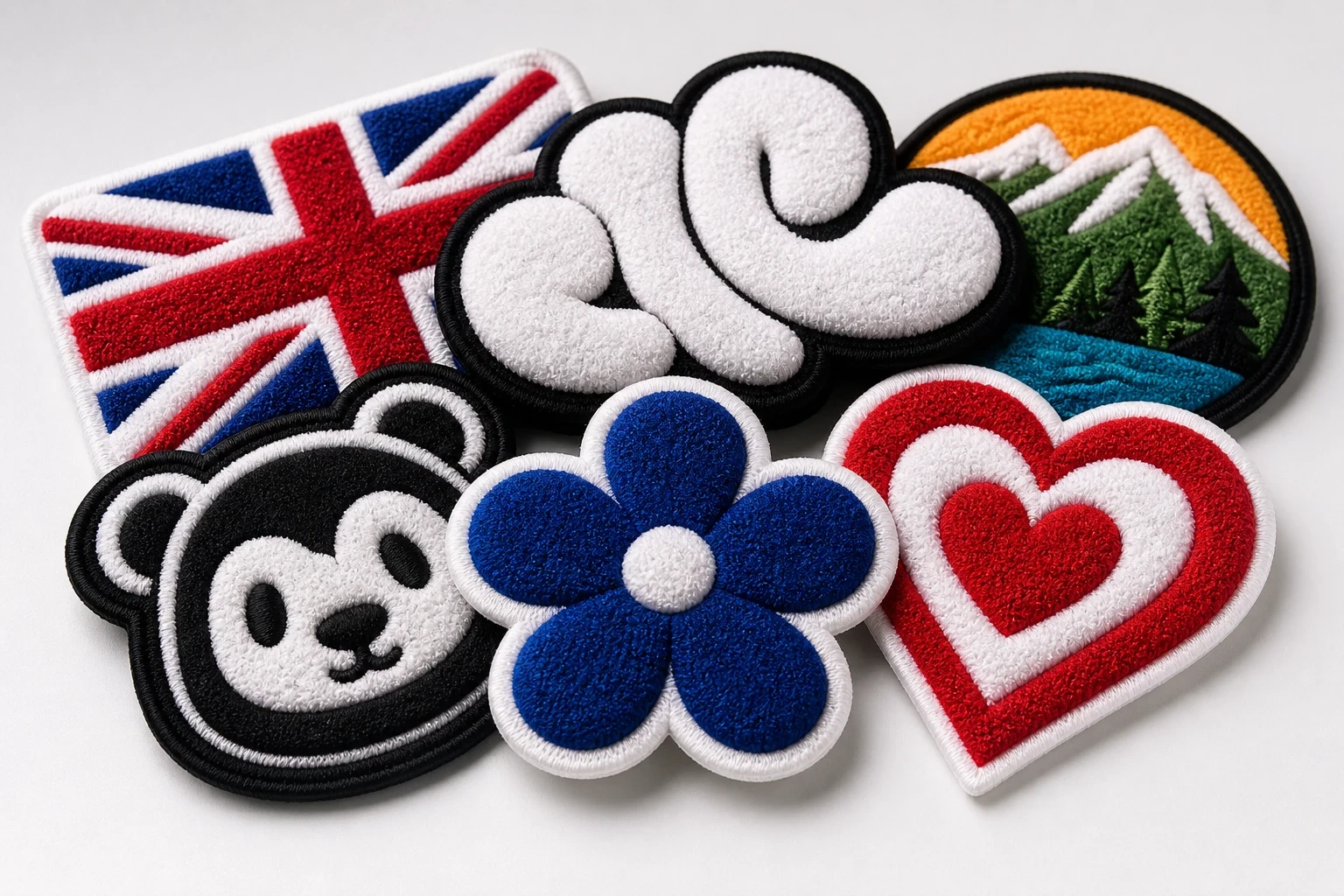
Puff embroidery uses foam beneath selected stitched areas. The thread covers the foam, creating a raised surface that catches light and gives a badge a more pronounced profile than standard embroidery. It is often chosen for bold initials, sports lettering, streetwear marks, club names and simple symbols.
The raised effect is not suitable for every drawing. Tiny text can lose its counters, narrow lines may become crowded and close-spaced details can merge. A design that looks clear on a phone screen may need simplifying once it is reduced to a 2.5-inch chest patch.
Puff embroidery is also not the same as adding a thick border to a normal badge. The foam has to be planned into the digitised file, and some parts of the design may remain flat. A raised word with a flat merrowed crest around it can work well, provided the two levels are intentional.
Where the raised effect works best
- Large block capitals on football training tops, varsity jackets and team outerwear.
- Short brand names on heavyweight sweatshirts, caps and work jackets.
- Bold club initials on biker vests or removable Velcro panels.
- Simple icons, numbers and emblems with clear spaces between the parts.
- Small collections where the extra height is part of the visual identity rather than a way to reproduce every artwork detail.
For a design with fine wording, gradients, photographic detail or many small colour changes, compare woven patches or printed patches. Printed is flatter; that is the point when a clean image or small text needs to remain legible.
Puff embroidery patches UK artwork checklist
Start with the artwork, not the order quantity. Send the clearest version available, ideally a vector file such as AI, EPS or SVG, although a sharp PNG can still help with the first assessment. Tell our team which parts must be raised rather than leaving that decision to guesswork.
A football club may want the club initials raised but the small founding year flat. A hospitality company might want a raised monogram on a dark polo, while a cadet unit may need a readable unit name and a separate insignia. Those are different production instructions even if the artwork is supplied as one image.
Check these details before sending the file
- Spelling, punctuation, dates, initials and any registered wording.
- Which letters, numbers, icons or panels should have the puff effect.
- The intended thread colours, including a clear contrast between the raised fill and surrounding border.
- The final patch shape: round, shield, rectangle, custom outline or another silhouette.
- The smallest text and narrowest gap in the design.
- Whether the artwork should be reproduced as supplied or simplified for stitching.
- Whether a merrowed edge, satin edge or stitched outline is required.
- Whether the patch will be viewed from a distance, handled regularly or washed frequently.
Do not assume that every colour on a screen maps directly to thread. Thread has its own surface, sheen and available colour range. A free digital mockup gives you a useful visual check, but it is still a digital representation rather than a physical sample.
Confirm size, raised areas and proportions
Give the finished size in inches, not just the artwork dimensions. A patch that is 3 inches wide may look comfortable on a jacket back but oversized on a left-chest polo. For a cap, the curve and limited front panel can matter as much as the width.
Measure the available space on the actual garment. Nylon shells can have seams, pockets and weatherproof coatings close to the intended position. Wool coaches jackets may accept a large back badge but need a carefully chosen attachment method. School blazers often need a neater, smaller crest than a match-day jacket.
| Specification | What to confirm | Why it matters |
|---|---|---|
| Finished size | Width and height in inches, including the border | The patch must fit the panel without covering seams, pockets or existing branding. |
| Raised zones | Which letters, numbers or shapes use foam | Too many raised areas can make a detailed design look crowded. |
| Smallest detail | Smallest text, gap and line weight | Very fine details may need simplifying or a different patch method. |
| Patch shape | Round, shield, rectangle or custom outline | The outline affects the available stitching area and final appearance. |
| Border | Merrowed edge, stitched satin edge or another finish | The border frames the design and affects the outside measurement. |
| Quantity | Number of pieces for each separate design | The minimum is 5 pieces per design; different designs are not automatically combined. |
| Garment | Polo, jacket, blazer, bag, cap or Velcro panel | Fabric weight and use help determine the appropriate backing. |
A useful rule is to protect the breathing room around the raised lettering. If the foam-filled letters run into a narrow border, the edge can look heavy. If the design contains a small date beneath a large word, ask whether the date should remain flat or be enlarged.
Choosing puff, flat embroidery or another method
Puff embroidery is a visual choice, not automatically an upgrade to every patch. It suits bold, tactile marks. Flat embroidered patches are often better for complex crests, long wording and designs that need consistent detail across a smaller area.
| Patch method | Best suited to | Main trade-off |
|---|---|---|
| Puff embroidery | Bold initials, short wording, sports marks and raised logos | Small detail and close spacing may need simplifying. |
| Flat embroidery | Traditional crests, uniforms, club badges and detailed stitched artwork | It has less height and a flatter visual profile. |
| Woven | Fine lines, small lettering and a smooth, compact surface | It does not have the same raised texture as embroidery. |
| Printed | Gradients, photographs, fine artwork and very small text | The surface is flatter and may not give the tactile effect some brands want. |
| PVC | Water-resistant styling, bold moulded shapes and outdoor equipment | It has a rubber-like finish rather than a thread-based surface. |
| Chenille | Large varsity letters, school teams and soft textured crests | It is thicker and more limited for small detail. |
If you are comparing methods, the difference between puff and flat embroidered patches explains the practical visual choice in more detail. For a large varsity-style letter, chenille patches may be the better direction. For a technical outdoor badge, PVC patches can be worth considering.
Choose the backing for the garment
Backing should be chosen alongside the garment, not added as an afterthought. A sew-on patch is usually a dependable choice for jackets, uniforms and items that will be washed or worn repeatedly. It needs to be sewn through a suitable part of the garment, avoiding waterproof seams and very thin lining where possible.
Iron-on backing is convenient for many cotton and polyester garments, but the application instructions matter. Heat-sensitive nylon shells, coated fabrics and some technical outerwear may not tolerate the required temperature. An iron-on that looks secure on day one can peel after a dryer cycle if the garment and application conditions are wrong.
Sew-on, iron-on or Velcro?
- Sew-on: a sensible choice for permanent club badges, workwear, wool coaches jackets and biker vests. It takes longer to apply but can suit repeated wear.
- Iron-on: useful for suitable fabrics where a quick application is wanted. It should not be treated as universal, particularly on nylon shells, coated fabrics or garments exposed to frequent heat.
- Hook-and-loop or Velcro: suitable for removable identity panels, tactical clothing, event teams and kit that needs different badges for different roles.
- Adhesive options: useful for temporary display or selected lightweight applications, but the surface, washing routine and handling should be discussed first.
Not sure whether the logo should be raised, flat, woven or printed? Send the artwork and intended garment to The Customized Patches. We can show the proposed treatment on a free digital mockup, usually within 12 hours, before production.
GET A FREE MOCKUPA biker and motorcycle club patch may need a firm sew-on finish because leather and heavy denim are handled differently from a polo. A football club may prefer sew-on for match jackets but Velcro for training equipment. If you are ordering for a biker and motorcycle club patches project, include a photograph of the vest or jacket panel with the quote.
For more size and backing guidance, see Custom embroidered patches UK Sizing and Backing Options Explained. The same basic principle applies to puff work: the best backing is the one that suits the base fabric, application method and expected use.
Check the garment before approving production
Send the garment type, fabric and placement with your order notes. A patch on a cotton sweatshirt has different requirements from one on a nylon shell, wool coaches jacket, leather vest or school blazer. If there is an existing badge, pocket, zip or seam nearby, show that too.
Do not rely only on a stock photograph. A real placement photograph helps identify awkward curves, narrow panels and obstructed sewing access. It also gives the production team a better idea of how the patch will be viewed once worn, rather than laid flat on a desk.
Common garment problems
- Nylon shells may mark, melt or lose their finish under excessive heat, so iron-on needs careful checking.
- Wool coaches jackets can have a dense weave and lining that make sewing access less straightforward.
- Leather and heavy denim need a suitable needle and a clear placement plan; a thick patch can change how the garment sits.
- Polo shirts can stretch, making a large or heavy patch pull the fabric unless the size and placement are sensible.
- School blazers may have a badge position dictated by the uniform design, leaving less room for a raised border.
- Velcro panels need the correct hook or loop component and dimensions, not simply a standard iron-on backing.
If the badge is for a removable panel, state whether the patch should carry hook or loop. It is a small detail, but choosing the wrong side can make a finished patch unusable on the garment.
Quantity, pricing and the 5-piece minimum
The Customized Patches accepts a minimum order of 5 pieces per design. That means five identical patches of one approved artwork. If you need a first-team crest, reserve-team crest and sponsor badge, treat them as separate designs and ask for each quantity to be listed clearly.
Pricing depends on more than the number of patches. Finished size, stitch coverage, number of thread colours, raised areas, border, backing, artwork preparation and delivery requirements can all affect a quotation. A large, heavily stitched badge may take more production work than a small, simple initial even if both are ordered in the same quantity.
What to include in a quote request
- The artwork file and a note explaining which parts should be raised.
- The finished width and height in inches.
- The number of pieces required for each separate design.
- The garment type, fabric and patch placement.
- The required backing: sew-on, iron-on, Velcro or another option.
- Preferred thread colours or brand colour references.
- Whether you need a merrowed edge, stitched border or custom outline.
- The delivery postcode and date the patches are needed.
- Any requirement for separate packing by team, branch, size or role.
A quote becomes more useful when the specification is complete. If the size, backing or raised treatment changes after approval, the price or schedule may need to be reviewed. For a wider pricing discussion, read How Much Do puff embroidery patches UK Cost in the UK?.
Mockup approval: the check that prevents avoidable mistakes
The mockup is where you catch the mistakes that are easy to miss in an email. Check every letter, number and accent. Confirm the raised sections, border thickness, patch shape, colour order, backing and approximate placement against the garment.
The Customized Patches provides a free digital mockup usually within 12 hours. It is not a substitute for a physical sample, and the appearance of thread can vary from a screen image, but it gives you a clear approval stage before the order is produced.
Use this approval checklist
- Read the wording at the displayed size, not only while zoomed in.
- Check that the raised foam areas are where you expect them to be.
- Confirm that the outline has enough separation from the raised lettering.
- Check the patch dimensions, including the border.
- Compare thread colours with your brand or club references.
- Confirm sew-on, iron-on or Velcro backing.
- Check the quantity for each design.
- Confirm the delivery address and required date.
- Reply with clear approval or list changes in one message where possible.
Production begins only after approval. That protects both sides: you have a chance to check the specification, and the production team has an agreed version to work from. If a spelling error is noticed after approval, raise it immediately rather than assuming it can be changed without affecting the schedule.
Ordering times and UK delivery planning
Build the order around the date the patches must be on the garments, not simply the date you want them dispatched. Allow time for artwork questions, mockup review, approval, production and UK delivery. A club preparing for a tournament, a school arranging a blazer handover and a brand preparing a clothing launch may each have a different level of urgency.
The free mockup is usually sent within 12 hours, but that is the design review stage rather than a promise that the complete order will arrive in 12 hours. Production time depends on the approved specification, quantity, current workload and the complexity of the design. Ask for the expected schedule against your actual deadline.
Give our team a usable deadline
- State the date the patches are needed, not only the date of an event.
- Mention bank holidays, team travel, school terms or launch dates that affect delivery.
- Allow time to apply sew-on patches or test an iron-on backing on the garment.
- Order replacement pieces or spares at the same time if the badges will be hard to source later.
- Use the full delivery address, including the correct UK postcode and any reception or unit details.
Name sew-on, iron-on or Velcro on the quote and include the date the patches need to be on the garments. The Customized Patches will show the proposed backing on a free digital mockup, usually within 12 hours, and will produce only after approval.
GET A FREE MOCKUPFor a branch network or national organisation, confirm whether all pieces should ship together or go to several UK addresses. Separate packing can be helpful, but it needs to be included in the ordering notes rather than assumed.
Examples from real UK patch orders
A football club usually wants a badge that can be recognised from the touchline. Raised initials or a short team name can work well on a jacket, while a detailed crest may be better as flat embroidery. The practical question is not simply whether the badge can be made; it is whether the players, coaches and parents will still read it at the finished size.
Cadet units often need disciplined spacing, clear lettering and repeatable placement across several garment types. If one unit uses a blazer and another uses a field jacket, the same artwork may need different sizes or backing arrangements. Put those differences in the quote rather than ordering one version and trying to adapt it later.
Hospitality polos need a neat chest placement that does not overpower the garment. A raised monogram can give a premium feel, but a large foam-filled area may be uncomfortable or too prominent on a lightweight polo. A small, controlled raised mark is often more appropriate.
Biker vests and heavy jackets can carry larger club lettering, but the application method must match the base material. Leather, denim, lining and existing badges all affect how easy the patch is to sew. A photograph of the vest front or back makes the discussion much more precise.
School blazers are less forgiving because the badge position and uniform colours are usually fixed. Check the available area, border and wording carefully. If the crest includes a motto in small type, ask whether a woven patch or flat embroidered version would preserve more detail than puff.
Mistakes to avoid before you order
Most problems are specification problems rather than stitching problems. The wrong size, missing backing instruction or unapproved colour can lead to a patch that is well made but unsuitable for the intended garment.
- Ordering from a low-resolution screenshot and expecting every small detail to be reproduced.
- Making every part of the artwork raised, including tiny wording and narrow outlines.
- Giving an overall size but not explaining whether the border is included.
- Assuming five pieces can be made up of five unrelated designs.
- Choosing iron-on backing for a nylon shell without checking heat suitability.
- Approving a mockup without reading the wording at the finished scale.
- Leaving the garment type and placement out of the order notes.
- Treating the free mockup time as the complete delivery time.
- Changing the design after approval without asking how the change affects the quotation or schedule.
- Forgetting spare patches for future replacements, new players or damaged garments.
The Common Mistakes to Avoid When Ordering puff embroidery patches UK guide covers these points in more detail. A short check before approval is usually easier than correcting a badge after it has been applied to a uniform.
Final puff embroidery patches UK order checklist
Before sending approval, read through this list with the person who will receive the patches and the person who understands the garment. That may be a club secretary, kit manager, brand founder, school administrator or operations lead. Two pairs of eyes often catch different errors.
- The artwork file is the latest version.
- The wording, spelling and dates are correct.
- The raised areas are clearly marked.
- The finished size is stated in inches.
- The patch shape and border are confirmed.
- Thread colours have been reviewed.
- The smallest text has been checked at the intended size.
- The garment and placement are stated.
- The backing is confirmed as sew-on, iron-on, Velcro or another agreed option.
- The quantity is at least 5 pieces per design.
- The digital mockup has been reviewed.
- The delivery address and deadline are correct.
- Approval has been sent clearly before production.
If you are still deciding between a raised finish and a flatter method, compare 3D embroidered patches with embroidered patches, printed patches or leather patches. The right choice depends on the artwork, garment, handling and the visual result you want—not on the name of the technique alone.
For UK buyers who want to start with an artwork check, use the free mockup quote. Include the design, size, garment, backing, quantity and deadline. The Customized Patches can then assess the brief, prepare a free digital mockup usually within 12 hours and wait for your approval before production.
Frequently asked questions
What should I confirm before ordering puff embroidery patches UK?
Confirm the finished size in inches, raised areas, thread colours, border, patch shape, backing, garment, quantity and delivery date. Check the digital mockup carefully for spelling, proportions and placement. The minimum is 5 pieces per design, and production starts only after approval.
What is the minimum order for puff embroidery patches from The Customized Patches?
The minimum order is 5 pieces per design. Five pieces means five patches made from the same approved artwork. Separate club badges, team names or sponsor designs should be listed separately, even if they are ordered at the same time.
How quickly can I receive a puff embroidery mockup in the UK?
The Customized Patches usually provides a free digital mockup within 12 hours. This is the artwork review stage, not a promise that the complete patch order will arrive within 12 hours. Production and UK delivery depend on the approved design, quantity and agreed schedule.
Can puff embroidery patches go on a nylon jacket?
They may be suitable for a nylon jacket, but the backing and application method need checking first. Nylon shells can be sensitive to heat, so iron-on backing should not be assumed. Sew-on or Velcro may be more suitable depending on the jacket construction and intended use.
Are puff embroidery patches better than flat embroidered patches?
Neither is automatically better. Puff embroidery gives selected areas a raised, tactile profile and suits bold lettering or simple marks. Flat embroidery is often more suitable for detailed crests, small wording and fine outlines. The garment, finished size and artwork should decide the method.
Can I approve production before seeing a mockup?
You can provide the artwork and order details, but The Customized Patches produces only after approval. The free digital mockup, usually supplied within 12 hours, gives you a chance to check spelling, colours, raised areas, size, border and backing before production begins.
Ready to produce custom patches for your UK team or brand?
GET A FREE MOCKUP