
How Much Detail Can a Patch Hold? Embroidery vs Woven vs Printed
Printed patches generally preserve the most photographic detail and gradients. Woven patches suit fine line-art logos and smaller lettering, while embroidery suits bold shapes with raised texture. Detail depends on finished size, contrast, lettering and production method; no patch type can make tiny artwork readable simply by reproducing it.
Key takeaways
- Printed patches are usually the best choice for photographs, shading and gradients.
- Woven patches generally retain finer lettering and line work than standard embroidery.
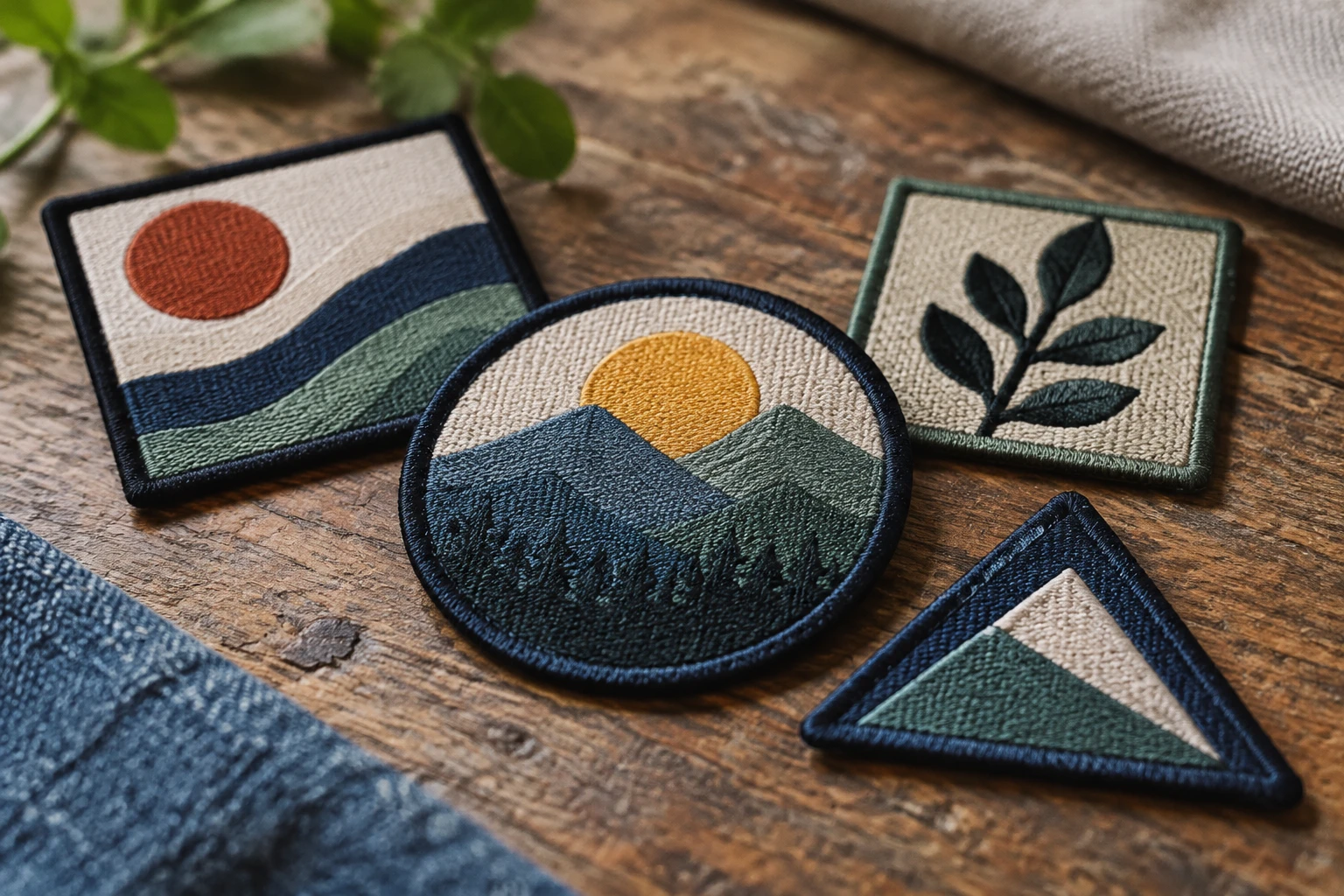
- Embroidery rewards bold shapes and open spacing with a raised, textured finish.
- Judge artwork at finished size; a digital mockup is not proof that every tiny detail will reproduce.
Patch fine detail limits depend on the production method and finished size: printed patches generally hold the most photographic detail, woven patches retain finer thread-based detail, and embroidery suits bold shapes. For photographs or gradients, choose print; for intricate line-art logos, start with woven.
Embroidery remains a good choice when raised texture matters more than tiny features. Before choosing, identify what must stay recognisable: the club name, a narrow outline, a face or a small symbol.
Patch fine detail limits: how the three types compare
Embroidered patches build designs with stitches over a base fabric. Thread width, stitch direction and fabric movement affect the result, so narrow gaps can close and small letters can fill in.
Woven patches form the design within a fine weave, allowing smaller features than standard embroidery. Printed patches reproduce the image with ink rather than separate stitched colour areas, making them better suited to tonal changes.
| Feature | Embroidered | Woven | Printed |
|---|---|---|---|
| Fine outlines | Often need thickening or simplifying | Good for fine, distinct line work | Good if the source artwork is sharp |
| Small lettering | Needs generous height and spacing | Usually clearer at smaller sizes | Can reproduce fine text, but readability still limits size |
| Photographs | Requires substantial stylisation | Requires reduction into woven colour areas | Best match for faces and photographic shading |
| Gradients | Stitch blending approximates the effect | Weave can simulate tonal transitions | Best suited to smooth transitions |
| Surface | Raised texture and visible stitch direction | Flatter textile finish | Flat image on a textile surface |
| Main compromise | Texture limits tiny detail | Fine weave still has physical limits | Less raised thread character |
Which type suits your photograph or line-art logo?
Photographs and shaded illustrations: choose printed
A photograph depends on many small tonal changes, not just outlines. Print preserves these more faithfully than translating them into stitch or weave; use a sharp original and crop around the subject rather than squeezing a whole scene onto a badge.
For example, a hypothetical commemorative portrait could lose facial detail if the background occupies most of the patch. Our guide to photo and gradient patches explains the options.
Line-art crests: choose woven unless texture takes priority
Woven is a useful starting point for crests with fine dividing lines, small lettering and closely spaced symbols. Keep solid colours clearly separated; a pale grey outline against white remains weak even if the weave reproduces it.
Need to keep fine lines without losing a textile finish? Send your artwork for a free digital mockup, usually within 12 hours, and ask us to review it for woven production.
GET A FREE MOCKUPChoose embroidery for a bold monogram or simplified crest where the stitched surface is part of the appeal. If tiny decorative marks are expendable, removing them may give a clearer result than changing the entire patch type.
How small can lettering and gaps be?
There is no reliable universal minimum for every font and patch process. As provisional design targets—not production guarantees—allow roughly 5–6 mm (0.20–0.24 in) letter height for standard embroidery and 3–4 mm (0.12–0.16 in) for woven lettering, then request an artwork check.
These measurements refer to the letters themselves, not the surrounding text box. Thin scripts, serifs and tightly spaced capitals can need more room; font choices for patch lettering matter as much as nominal height.
- Print the layout at its intended dimensions and inspect it without zooming.
- Check the openings inside letters such as A, B and R; closed openings make words harder to identify.
- Keep important text clear of the finished border and confirm the usable artwork area.
- If a crest fails at 60 mm (2.36 in), compare a simplified version with an 80 mm (3.15 in) version before choosing.
Will better artwork fix a crowded design?
Better source artwork removes avoidable blur, but cannot overcome thread width or make tiny text readable. Supply vector artwork where available for logos, and the original high-resolution image for photographs; enlarging a screenshot does not restore missing detail.
For print, 300 pixels per inch at finished size is a useful artwork target, not a guarantee of output quality. A patch 76 mm (3 in) wide would need roughly 900 pixels across at that resolution; see our artwork file-format guide before exporting.
A digital mockup checks layout, spelling, proportions and intended colours. It does not physically demonstrate thread behaviour or exact colour reproduction, so flag critical details and ask how they will translate into the chosen process.
Can the border or garment undermine the design?
A thick overlocked border, often called a merrowed edge, occupies space that cannot also hold lettering. On a small patch, simplify the outer text ring or increase the overall size rather than pushing letters against the edge.
Send the artwork, dimensions and garment through our [free mockup quote](#quote) form, noting any detail that cannot change. We provide a free digital mockup, usually within 12 hours, before you approve production.
GET A FREE MOCKUPBacking changes attachment, not image resolution. A large, stiff patch can sit poorly on a lightweight polo or curve awkwardly around a canvas cap; confirm the garment and placement alongside the artwork.
Do not assume iron-on is suitable for a nylon shell: heat may damage the fabric or coating, while stitching can create leak paths. Read Patches on Waterproof Jackets before choosing attachment for waterproof clothing.
What should you send for a quote, and when does production start?
The Customized Patches makes patches to order from your artwork, with a 5-piece minimum per design and free shipping across the United Kingdom. Quotes start from £60; request a quote for the actual specification rather than treating that starting figure as a fixed price.
- Upload the original artwork and state the finished width and height.
- Name the details that must remain: wording, small symbols, outlines or photographic features.
- Specify quantity per design, preferred patch type, garment, placement and backing.
- Give your required delivery date and ask for production and shipping timings.
- Review the mockup, clarify any simplified details and approve the final specification.
Our free digital mockup is usually ready within 12 hours; this is not a manufacturing or delivery promise. We produce only after approval, so confirm the schedule and any unresolved detail questions before approving.
Frequently asked questions
What determines patch fine detail limits?
Finished size, thread or print process, contrast, font shape and spacing all matter. A method may reproduce a tiny feature without making it readable, so check both production feasibility and actual-size clarity.
Are woven patches always better than embroidery?
No. Woven generally handles finer detail, while embroidery provides raised texture that suits bold logos. Choose according to the features you need to retain and the finish you want.
Can embroidery reproduce a photograph?
It can interpret a photograph as stitches, but fine shading and facial detail usually need simplification. Printed patches are generally the better choice when photographic likeness matters.
Will printing make very small text readable?
Not necessarily. Print avoids some thread-related limits, but letters still need enough physical size and contrast for the viewing distance. Enlarge essential wording or remove secondary text.
Does a digital mockup prove every fine line will reproduce?
No. A mockup shows the proposed design, not a physical production test. Ask specifically about narrow gaps, tiny lettering and colour transitions before approving artwork.
Can I order five patches to check my design?
The minimum is five pieces per design. That allows a small made-to-order purchase, but a physical sample is not included in the free digital mockup offer. Confirm costs and timing for any physical checking you need.
Ready to produce custom patches for your UK team or brand?
GET A FREE MOCKUP