How custom embroidered patches UK Can Strengthen Your Brand Identity
Custom embroidered patches UK strengthen brand identity by putting the same recognisable colours, symbols and wording across jackets, uniforms, bags and teamwear. They give a club or business a physical brand asset that people can see and handle. The Customized Patches provides a free digital mockup usually within 12 hours, with a 5-piece minimum per design.
Key takeaways
- A patch makes a logo visible on more than one garment, so teams and businesses can repeat a consistent identity across jackets, polos, bags and uniforms.
- Thread gives a raised, tactile finish that suits crests, initials and bold shapes, but very small text and fine gradients may need simplifying.
- Backing, edge, size and garment fabric affect how the patch performs; nylon shells, wool coaches and Velcro panels need different decisions.
- The Customized Patches has a 5-piece minimum per design, provides a free digital mockup usually within 12 hours and produces only after approval.
Custom embroidered patches UK can strengthen brand identity by putting the same recognisable logo, colours and wording on jackets, uniforms, bags and teamwear. They turn a digital mark into something people can see, touch and wear, which helps a club, team or business look consistent wherever its people are working or competing.
The useful part is not simply adding a badge. The patch has to suit the garment, remain readable at its finished size and use the right backing for the job. The Customized Patches supplies UK customers with a free digital mockup usually within 12 hours, has a 5-piece minimum per design and produces only after the artwork has been approved.
Why custom embroidered patches UK make a brand easier to recognise
A logo on a website is easy to change or overlook. A stitched patch on a navy club jacket, a school blazer or a hospitality overshirt is more physical. It sits at chest height, appears in photographs and travels with the wearer from one setting to another. That repeated exposure is useful for brands that need recognition without printing a large slogan across a garment.
Patches also give people a shared visual marker. A football club can use a crest on tracksuit tops and kit bags. A cadet unit can place a carefully sized insignia on uniform. A café group can use one shaped emblem across aprons, fleece jackets and staff bags. The garments may differ, but the patch creates a common point between them.
The raised thread is part of that recognition. It catches light differently from a flat print and gives a logo a defined edge. That does not make embroidery the right answer for every artwork. Printed is flatter; that is the point when a design contains a photograph, a smooth colour fade or small lettering that thread cannot reproduce cleanly.
A patch can carry more than a logo
Strong identity often comes from a small set of repeated details rather than one oversized mark. A patch might combine a club crest with a founding year, a business symbol with a short service name, or a team monogram with a local reference. The wording must remain brief enough to read from normal viewing distance.
For organisations operating across Britain, a patch can also give local identity some room. A Welsh mountain club, a Manchester music venue, a London streetwear label or a Scottish outdoor group may use place-related colours or symbols without changing the main logo. The UK city pages can help if you are comparing a local project with a wider UK order.
Start with the brand details that must not change
Before discussing thread counts or edge finishes, decide which parts of the brand are fixed. Usually that means the logo shape, the main colour, the wording and the relationship between the symbol and the text. If three departments send three slightly different versions of the logo, production cannot correct the identity problem by itself.
- Use the approved logo rather than a screenshot taken from social media.
- List the thread colours that matter most, especially if the brand uses a distinctive navy, red, green or gold.
- Say which wording is essential and which wording can be removed at small sizes.
- Check whether the patch will sit beside printed or woven branding on the same garment.
- Decide if the patch should look formal, sporty, heritage-led, technical or deliberately informal.
- Keep the shape repeatable if the patch will be used on different garment sizes.
A circular merrowed crest gives a different impression from a laser-cut label with an irregular outline. Neither is automatically better. A school may want a traditional edged badge on a blazer, while a cycling brand may prefer a compact heat-cut shape on a technical gilet. The finish should support the identity rather than compete with it.
Protecting brand consistency across suppliers and garments
A useful patch specification records the finished width and height, backing, border, base fabric and colour references. Keep that information with the artwork. It reduces the chance of ordering a 3-inch chest badge for one batch and a much smaller badge for the next without realising the visual difference.
It is worth checking the garment in person. A patch that looks balanced on a heavy cotton jacket may appear oversized on a polo. A bright embroidered border can work on black workwear but become hard to distinguish on a dark navy fleece. Send a photograph or describe the fabric when requesting a quote.
Choosing the right patch construction for the identity
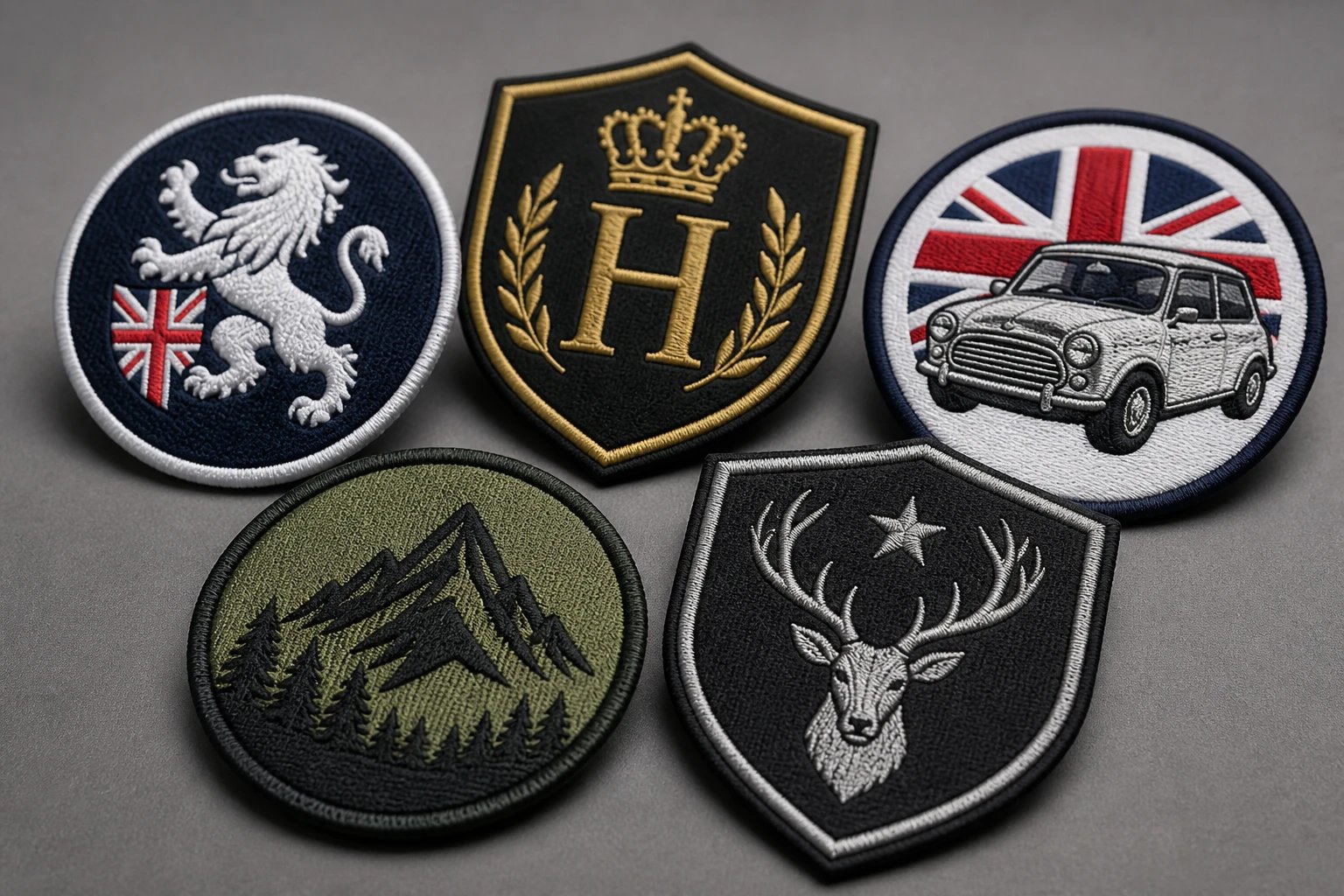
Embroidered patches suit bold lettering, crests, initials, mascots and simple symbols. The thread creates texture and a clear border, which is why it is common on team jackets, school clothing, club kit and branded workwear. See the embroidered patches hub for the main options.
There are sensible exceptions. A detailed illustration with many thin lines may be clearer as a woven patch, because the surface is flatter and can hold finer drawn detail. A photograph, large gradient or continuous artwork may work better as a printed patch. A raised sports-style mark could suit 3D embroidered patches, but the height needs to fit the garment and the design.
| Patch type | Best for | Main visual result | Trade-off to consider |
|---|---|---|---|
| Embroidered | Crests, bold logos, initials, teamwear and work jackets | Raised thread with a traditional stitched appearance | Very small text, fine lines and smooth gradients may need simplifying |
| Woven | Detailed linework, compact labels and flatter brand marks | Flat, tightly woven surface with more even small detail | Less textured than embroidery and may not give the same classic crest effect |
| Printed | Photographs, gradients, fine illustrations and full-colour artwork | Flat ink-based image with broad colour freedom | Less tactile, and the finish does not provide the raised thread appearance |
| 3D embroidered | Bold lettering, sports marks and selected statement logos | Raised foam-supported areas with extra height | Fine detail is restricted and the raised sections need sensible protection |
| PVC | Outdoor labels, technical clothing and bold rubberised symbols | Smooth, moulded and weather-focused appearance | It has a different character from thread and may not suit a traditional club crest |
| Leather | Heritage brands, hats, bags and understated marks | Stamped or engraved surface with a natural material feel | Colour and fine artwork options differ from textile patches |
Some customers try to make one patch perform every role. That can lead to compromises. A club might need an embroidered crest for formal jackets, a woven version for a small cap and a printed version for a highly detailed event graphic. Keeping the core shape and colours consistent can create a stronger family of products than forcing one construction onto every item.
For a hard-wearing outdoor or technical project, review PVC patches. For a heritage clothing or cap project, compare leather patches. A biker group may need a large back design alongside smaller chest marks, so the biker and motorcycle club patches guide is a useful starting point.
Size, shape and edge details affect the message
Size is a branding decision as well as a production decision. A 3-inch patch can work well on a jacket chest or a bag pocket, while a larger back patch needs enough room for the design to breathe. A patch that is too small may turn a clear business name into a dark line of thread.
Not sure whether thread, woven detail or ink will show your logo properly? Send the artwork and the intended garment. GET A FREE MOCKUP and compare the visual direction before you produce.
GET A FREE MOCKUPMeasure the actual placement area in inches. Check the width of the jacket panel, the curve of a sleeve, the available space above a pocket or the height of a blazer chest. A circular badge can look balanced at one size, while a wide horizontal wordmark may need more width but less height.
Merrowed, heat-cut and laser-cut edges
A merrowed edge is the thick, rounded stitched border many people associate with traditional patches. It works particularly well for circles, shields and uncomplicated shapes. It adds definition, but it also takes up space around the artwork, so the inner design should not be packed against the border.
A heat-cut or laser-cut edge follows a more detailed outline and is often better for irregular silhouettes, letters or modern labels. The choice affects the feel of the finished badge. Read Merrowed vs Heat-Cut vs Laser-Cut Patches: Which Edge Should You Spec? before approving an unusual shape.
Backing is part of brand use, not an afterthought
Sew-on backing is the dependable choice for a permanent application. It is common on wool coaches, denim jackets, school blazers and garments that will be washed repeatedly. Iron-on backing is convenient for some cotton and polyester items, but heat, pressure and fabric compatibility matter; an iron-on patch that looks fine at first can peel after a dryer cycle.
Velcro backing makes sense where the identity needs to move between garments or where a role panel may change. It is useful on tactical-style outerwear, event uniforms and some club equipment. It also adds thickness and a hook-and-loop panel, so it may not suit a slim polo or a garment where a flat finish is required.
| Backing | Suitable use | Watch before ordering |
|---|---|---|
| Sew-on | Permanent branding on jackets, blazers, bags and heavy teamwear | Allow time for stitching and check the garment can take a needle |
| Iron-on | Selected garments where a quick application is useful | Confirm fabric, heat tolerance and care instructions; test before a full roll-out |
| Velcro | Removable role panels, tactical outerwear and transferable branding | The loop panel must be fitted to the garment and adds bulk |
| Adhesive | Temporary display or short-term positioning | Usually less suitable for repeated washing or long-term workwear use |
Nylon shells, waterproof fabrics and stretchy performance garments deserve particular care. Heat can mark or distort some materials, while stitching through a waterproof layer may affect its intended performance. A production desk needs to know the fabric before recommending a backing. The final brand experience includes how the patch sits after washing, not just how it appears in the mockup.
Where UK teams and businesses use branded patches
The best patch is usually the one placed where people already expect to see an identifier. For teams, that may be the left chest of a warm-up jacket, the sleeve of a coach jacket or the front of a kit bag. For a business, it may be the upper arm of a fleece, the chest of a polo or the front of an apron.
- Football, rugby, cricket and rowing clubs can mark squads, tours, anniversaries and staff roles.
- Cadet units and outdoor groups can use controlled insignia on suitable uniform items.
- Schools can place house, club or activity badges on blazers, bags and sports jackets.
- Hospitality teams can carry a compact emblem on polos, overshirts, aprons and outerwear.
- Trades and service businesses can add a recognisable badge to fleeces, work jackets and equipment bags.
- Streetwear and independent brands can use patches as product details rather than relying only on printed graphics.
- Motorcycle clubs can use coordinated chest, sleeve and back patches with clear sizing rules.
- Events and charity teams can issue a patch that remains useful after the event instead of becoming disposable clothing.
The garment changes the production advice. A wool coach jacket can carry a substantial sewn badge, but a lightweight nylon shell may need a carefully chosen application method. A school blazer may need a neat, traditional edge. A Velcro panel can solve the removal problem but will look different from a permanent crest.
For sports organisations, consistency matters across age groups. A junior shirt, adult jacket and coach's fleece may not have the same available space. It can be sensible to create one main patch and one smaller version, provided both use the same approved colours and recognisable symbol. The custom embroidered patches UK Best Practices for sports teams guide covers that planning point in more detail.
How to order without losing the identity in production
Start by sending the best artwork available, the intended quantity and a description of the garment. Include finished dimensions in inches, preferred backing, edge style, base colour and any deadline linked to a match, launch, uniform issue or event. If the order is for several departments, identify which designs are separate; the 5-piece minimum applies per design.
- Gather the approved logo, colour references and any wording that must appear.
- Measure the placement area and select a finished size that keeps the logo readable.
- Choose embroidered, woven, printed, PVC, leather or another construction based on the artwork and garment.
- Select the edge and backing, explaining if the patch will be sewn, pressed or attached to Velcro.
- Request a quote with the number of pieces for each design and the UK delivery details.
- Review the free digital mockup, usually within 12 hours, and check shape, spelling, colours, size and backing.
- Request amendments before approval if the artwork needs simplifying or the garment details have changed.
- Approve the final mockup. Production begins only after approval.
A digital mockup is not a photograph of a finished patch. It is a visual production reference showing how the approved design is expected to translate. Look closely at small wording, border thickness, the background fabric and the way the patch is shown on the garment. Ask questions before approval rather than relying on an assumption.
Lead times, quantities and delivery planning
The free mockup is usually available within 12 hours, but that is not the same as the manufacturing or delivery time. Production timing depends on the patch type, size, quantity, backing, artwork changes and current workload. Build in time for approval, especially if several people need to sign off a club crest or business logo.
The minimum is 5 pieces per design. That works for a small test run, a committee sample or a new business checking placement before ordering more. Larger quantities may make sense for a whole squad, staff uniform issue, retail launch or annual event, but the quantity should follow the real use rather than an arbitrary target.
For a UK-wide order, provide the complete delivery address and a contact who can approve the mockup. If you need patches for a fixture, trade show or uniform handover, say so at quote stage. It gives the production team a practical date to discuss instead of discovering the deadline after approval.
Name sew-on, iron-on or Velcro on the quote and tell us what the garment is made from. GET A FREE MOCKUP; we show the intended backing and design for approval before production starts.
GET A FREE MOCKUPCommon branding mistakes to avoid
The most common mistake is treating the patch as a miniature website. Customers send a logo with a long strapline, three fine borders and tiny contact details, then expect all of it to remain clear at 2.5 inches. A patch needs a hierarchy: the symbol first, the name second and optional detail only if the finished size supports it.
- Do not approve from a phone screen without checking the stated finished dimensions.
- Do not assume every brand colour will look identical in thread, ink and on the garment fabric.
- Do not choose iron-on simply because it is quick if the garment is heat-sensitive or heavily washed.
- Do not place a merrowed border around a shape with narrow internal gaps without checking how it will close up.
- Do not use one backing for a wool coat, nylon shell and removable Velcro panel without checking compatibility.
- Do not count several colour variations as one design when calculating the 5-piece minimum.
- Do not send production approval while wording, spelling or the placement image is still being debated.
- Do not expect embroidery to reproduce photographic detail; choose printed or woven construction where that is the real requirement.
Another avoidable problem is inconsistent placement. A chest patch that sits 2 inches from one jacket zip and 5 inches from another looks untidy in a group photograph. Create a simple placement instruction for whoever is applying the patches. It can state the distance from a seam, pocket or zip and whether the patch sits horizontally or follows a curve.
Care also affects the life of the identity. Follow the garment and backing instructions, avoid unnecessary tumble drying where the application method does not suit it and repair loose stitching promptly. The How to Wash and Care for Custom Patches guide gives practical advice for jackets, hats and uniforms.
A practical brand identity checklist
Use this checklist before requesting a quote or approving a mockup. It is deliberately plain because these are the details that cause delays at the production desk.
- The logo file is the current approved version.
- The patch purpose is clear: uniform, teamwear, merchandise, event clothing, bag or equipment.
- The garment material and colour have been identified.
- The finished width and height are stated in inches.
- The patch shape and edge have been selected.
- The required thread, print or material colours are clear.
- The backing matches the way the patch will be used.
- The quantity is listed separately for every design.
- The wording has been checked for spelling and legibility.
- The delivery address is in the United Kingdom and the deadline has been shared.
- The mockup will be reviewed by the person responsible for brand approval.
- Production approval will be given only after all details are correct.
If the project has several garment types, order a sample or small first run where appropriate. Five pieces per design is the minimum available from The Customized Patches, so a small batch can help a new business check the placement before committing to a larger uniform order. A sample is especially useful where the garment is unusually thin, stretchy, coated or heat-sensitive.
The final decision: use the patch to repeat the right things
A custom patch strengthens identity through repetition. The same crest on a team jacket, kit bag and coach's fleece tells people that those items belong together. The same business mark on workwear, delivery bags and event clothing helps customers connect different people and touchpoints with one organisation.
The result depends on sensible limits. Choose embroidery for texture and bold marks, but simplify detail where necessary. Choose printed construction when a flat, detailed image is the better result. Choose sew-on, iron-on or Velcro based on the garment and the way it will be used, not on appearance alone.
For UK teams, brands, clubs and businesses, the ordering process is straightforward when the specification is complete. The Customized Patches offers a free digital mockup usually within 12 hours, accepts orders from 5 pieces per design and produces only after approval. That gives you a chance to check the design before it becomes part of your public-facing clothing.
If you are comparing materials, start with the The Difference Between custom embroidered patches UK and printed patches, Explained guide. If the embroidery choice is already made, use Custom embroidered patches Sizing and Backing Options Explained to prepare the specification, then send the artwork for a quote.
Frequently asked questions
How do custom embroidered patches UK strengthen brand identity?
They repeat the same logo, colours, shape and wording across jackets, uniforms, bags, teamwear and work clothing. The raised stitched finish gives the mark a physical presence, while a consistent size and backing help different garments look like part of one organisation.
What is the minimum order for custom embroidered patches UK?
The Customized Patches has a 5-piece minimum per design. Different logos, colour versions or sizes are treated as separate designs, so list each one clearly when requesting a quote.
How quickly can I receive a mockup?
The Customized Patches provides a free digital mockup usually within 12 hours. This is the artwork approval stage, not a promise of completed production or delivery. Manufacturing starts only after you approve the final mockup.
Should a UK business choose embroidered or printed patches?
Choose embroidered patches for raised thread, bold logos, crests and traditional teamwear. Choose printed patches when the artwork contains photographs, gradients or fine detail that needs a flat surface. Printed is flatter; that is often the correct result for detailed artwork.
Which backing is best for a branded jacket?
Sew-on backing is usually suitable for permanent branding on denim, wool and heavier jackets. Iron-on can suit compatible fabrics but may peel after heat or washing if applied incorrectly. Velcro is useful for removable patches and role panels, particularly on garments designed for hook-and-loop attachments.
Can I use the same patch on a nylon shell and a wool coat?
The same artwork may work, but the application method may need to change. Nylon shells can be heat-sensitive or coated, while wool coats are often suited to stitching. Share the garment details before approval so the backing and application advice match the fabric.
Ready to produce custom patches for your UK team or brand?
GET A FREE MOCKUP