
Fine-detail woven patches UK: A Worked Example for a UK Brand
In this illustrative worked example, fine-detail woven patches UK are suited to logos with small lettering, thin outlines and intricate artwork that needs a flatter finish than traditional embroidery. In this hypothetical UK brand worked example, the customer used woven patches on heavyweight overshirts and caps, approved a free digital mockup within 12 hours, and ordered after checking size, backing and thread colours.
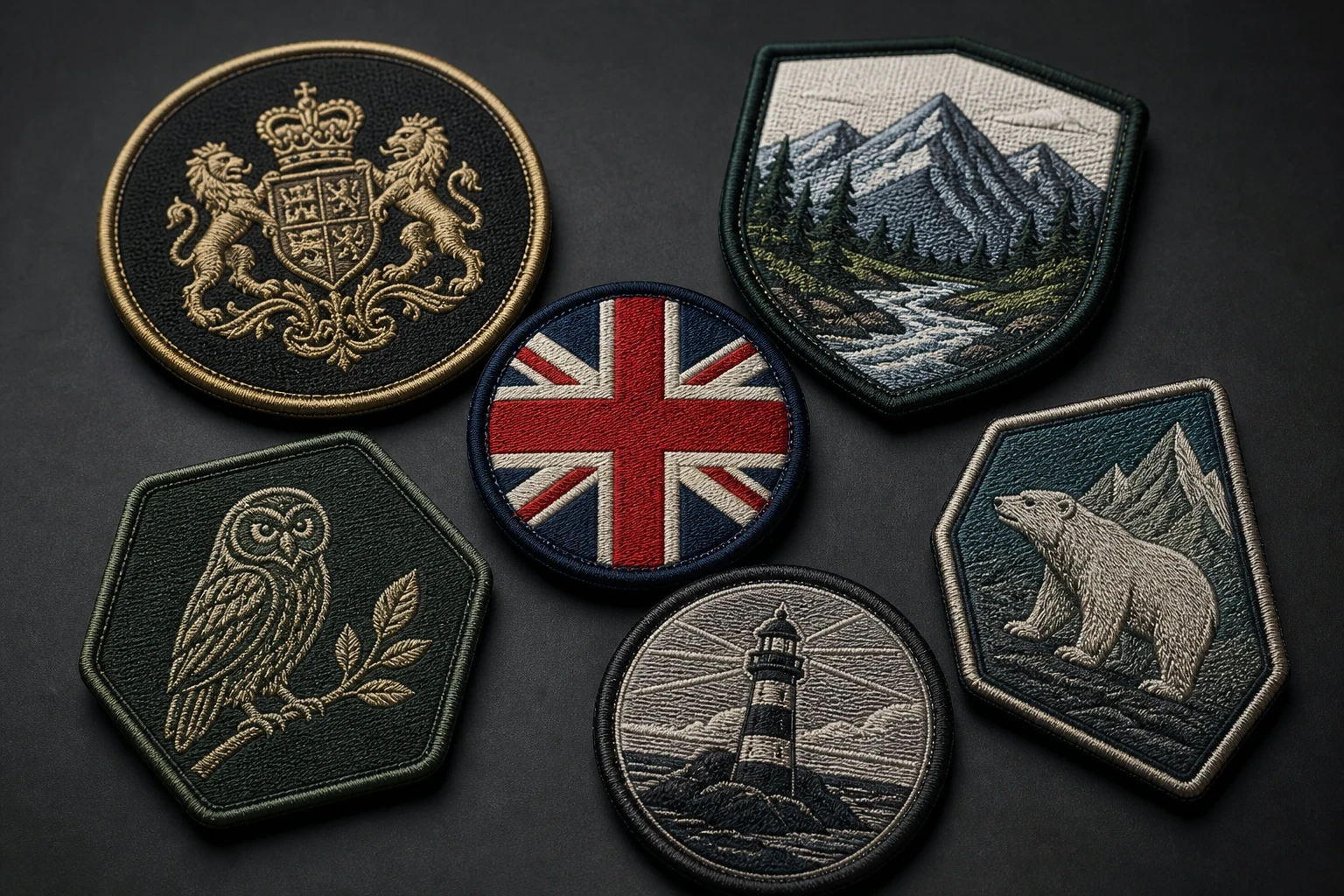
Key takeaways
- Fine-detail woven patches use a tightly woven face to reproduce small lettering, narrow lines and detailed logos with a flatter finish.
- The worked example brand chose woven patches for heavyweight overshirts and caps because the artwork needed more definition than standard embroidery could provide at the same size.
- The Customized Patches has a 5-piece minimum per design, provides a free digital mockup usually within 12 hours, and produces only after approval.
- Backing, garment fabric, finished size and artwork preparation affect the result as much as the thread colours.
Please note: this is an illustrative worked example, not a report on a real customer. The brand, garments and decisions below are a hypothetical scenario based on common UK patch briefs, written to show the questions worth asking and the choices involved. No customer results, sales figures or reviews are claimed.
Fine-detail woven patches UK work best when a logo contains small lettering, narrow outlines or several colour changes and needs a flatter face than ordinary embroidery. In this hypothetical UK brand worked example, the customer used woven patches on heavyweight overshirts and caps because the artwork looked crowded in a small embroidered badge.
In a project like this, the artwork is reviewed, the proportions are adjusted for the selected sizes, and a free digital mockup is sent, usually within 12 hours. The customer approved the design before production, ordered five pieces of the same design as the minimum, and selected backing according to the garments rather than treating every item as if it had the same fabric.
The UK brand's starting point: a detailed logo on small garments
The brand was developing a small run of heavyweight overshirts, six-panel caps and a few wool coaches' jackets for a UK clothing launch. Its logo included compact sans-serif lettering, a thin outer line, a small symbol and two internal gaps. At full size on a screen it looked simple. At roughly 2.5 inches wide, the details were much less forgiving.
That is a familiar production problem. A logo designed for a website header is not automatically ready for a patch. Tiny counters can close, narrow gaps can fill, and a border can become heavier than the mark inside it. The customer wanted the identity to remain recognisable without printing a large badge across the chest.
What the customer needed the patch to do
- Keep the small wordmark readable at a finished width of about 2.5 to 3 inches.
- Hold a clean dark outline around the symbol without making it look like a thick frame.
- Sit neatly on cotton twill, heavyweight canvas and a wool-blend coach jacket.
- Work on caps without using a badge so large that it distorted around the front panel.
- Allow a first order of five pieces per design rather than forcing a large stock commitment.
- Give the customer a digital visual to approve before any production work began.
The application list mattered. A flat woven face that looked right on a cotton overshirt could still need a different backing from a removable badge used on a team kit or a Velcro panel. We therefore treated the artwork, patch size, garment and attachment method as one specification.
Why fine-detail woven patches were chosen
Woven patches are made with finer threads arranged closely across the face of the badge. That gives the surface a flatter appearance and can retain smaller shapes and lettering than a heavily filled embroidered design at the same dimensions. They are not the right answer for every logo, but they were a sensible fit for this brief.
The customer compared the proposed woven finish with standard embroidered patches. Embroidery would have supplied more visible thread texture and a raised look, which can be exactly right for a football crest, a cadet unit badge or a traditional biker patch. Here, the small lettering was the priority, so a flatter woven face gave the artwork more room to read.
The trade-off: flatter detail versus raised texture
| Requirement | Woven choice | What to accept |
|---|---|---|
| Small lettering | Tightly woven face can keep compact lettering more defined | The letter size still has a practical limit; artwork may need simplifying |
| Fine outline | A narrow woven line can look controlled at a small badge size | Very fine lines may be adjusted in the production artwork |
| Raised texture | Flatter, cleaner surface with less relief | It does not give the bold raised pile of chenille or dense embroidery |
| Photographic artwork | Better for simplified logos and limited colour artwork | A photograph or smooth gradient may suit printed patches better |
| Removable badge | Can be supplied with Velcro where the garment has a compatible panel | Velcro adds thickness and must be allowed for in the garment system |
| Large traditional crest | Can work where detail and a flatter face are wanted | For a large heritage crest, embroidered thread texture may be the stronger visual choice |
Printed is flatter; that is the point. If the brief called for a soft photographic image, subtle shading or a very smooth colour blend, we would discuss printed patches rather than trying to force the artwork into woven construction. If it needed a rubberised finish for outdoor kit, PVC patches would be a different conversation again.
For this brand, the woven option kept the logo compact and legible while still giving the garment a proper badge rather than a flat transfer. The decision was based on the artwork and application, not on a claim that one patch type is universally better.
Artwork preparation made the bigger difference
The first file contained several details that were too delicate for a dependable small patch: a hairline around the icon, tight spacing between two letters and a small cut-out in the centre of the symbol. None of these were a problem on the brand's website. They needed attention at patch scale.
The practical artwork checks
- Confirm the finished patch width and height before judging the artwork. A 2-inch badge needs different decisions from a 4-inch back patch.
- Read the smallest text at the intended physical size, not only on a large monitor.
- Open small counters in letters such as a, e, o and p where the original spacing is too tight.
- Increase hairline strokes slightly if they are essential to the identity.
- Remove hidden layers, stray points and duplicate outlines from the supplied file.
- Keep the colour count purposeful. Similar screen colours may need a clearer thread distinction.
- Check the border and merrowed edge so the outer finish does not cover important artwork.
- Supply vector artwork where available, while also sending a clear reference image showing the intended colours.
This is where a mockup earns its place. A digital proof lets a customer see the proposed proportions, border, colour arrangement and general result before production. It is not a physical sample and cannot show every thread or fabric variable, but it catches spelling errors, awkward spacing and an unsuitable size early.
The brand asked to see the logo at two sizes: 2.5 inches for the cap and 3.25 inches for the overshirt. That comparison showed that the smallest lettering was comfortable on the overshirt but needed a slight simplification for the cap. One master design was not simply copied across every garment.
Not sure whether woven, embroidered or printed will hold your logo at the size you need? Send the artwork and garment details for a free digital mockup usually within 12 hours, then compare the finish before you produce.
GET A FREE MOCKUPSizing fine-detail woven patches UK buyers should check
Patch size should be measured against the garment panel, not chosen in isolation. A 3-inch badge can look balanced on a chest pocket but oversized on a cap front, while a badge that looks right on a jacket sleeve may disappear on a large work coat.
| Application | Useful starting range | Points to check |
|---|---|---|
| Cap front | About 2 to 3 inches wide | Measure the flat front panel and account for the curve at the sides |
| Overshirt chest | About 2.5 to 4 inches wide | Keep the badge clear of seams, pockets and heavy topstitching |
| Sleeve | About 2.5 to 4 inches wide | Check arm movement and whether a border will sit over a seam |
| Wool coach jacket | About 3 to 4.5 inches wide | Confirm the fabric can take heat if iron-on is being considered |
| Velcro panel | Match the existing panel dimensions | Allow for the hook-and-loop thickness and the direction of the badge |
| Small accessory | Often 1.5 to 2.5 inches wide | Small text may need removal or a larger finished badge |
The worked example order used a slightly larger woven badge for the overshirts and a simplified version for the caps. That was more useful than making every item carry an identical physical size. Brand consistency comes from the right proportions and recognisable artwork, not from ignoring the garment.
For another view of dimensions and attachment choices, see Woven patches Sizing and Backing Options Explained. Customers comparing texture can also look at 3D embroidered patches or chenille patches, although both create a different visual result from a fine-detail woven face.
Backing and garment choice were part of the specification
A patch can be beautifully made and still fail if the backing does not suit the garment. The brand initially asked for iron-on backing across the full order. We paused that assumption because the garments included nylon shells and a wool-blend coach jacket, and heat-sensitive fabrics need more care than a standard cotton twill.
| Backing | Good fit | Caution |
|---|---|---|
| Sew-on | Permanent use on overshirts, jackets, bags and uniforms | Needs a clean stitch line and access to the garment area |
| Iron-on | Suitable heat-safe cotton and similar fabrics when applied correctly | May peel after a dryer cycle or fail on unsuitable nylon, coated or delicate fabric |
| Velcro | Removable team badges, kit panels and tactical-style garment systems | The garment needs a matching panel and the badge will sit thicker |
| Adhesive for temporary display | Short-term presentation or packaging use | Not a substitute for a proper garment attachment method |
The overshirts were specified with sew-on backing. The caps used a suitable attachment plan for the front panel, and the removable panel requirement was kept separate rather than adding Velcro to every item. That reduced unnecessary thickness and gave the brand a more practical garment finish.
It is common to see iron-on patches peel after a dryer cycle, particularly when the garment has been washed hot, tumble-dried or pressed incorrectly. Iron-on is not automatically wrong, but the fabric, application temperature, pressure, cooling time and care routine all matter. For valuable wool coaches' jackets, a stitched solution is usually the safer discussion.
Ordering fine-detail woven patches from a UK manufacturer
The quote needs more than a logo attachment. We ask for the artwork, finished dimensions, quantity, backing, garment type, preferred border and any deadline. The quantity is important because The Customized Patches has a 5-piece minimum per design. Five pieces of one logo is different from five pieces split across several unrelated designs.
What the brand confirmed before production
- One woven design for the overshirts, ordered above the 5-piece minimum.
- A separate simplified cap design rather than shrinking the overshirt artwork without review.
- Finished sizes in inches for each application.
- Sew-on backing for the overshirts and a separate attachment plan for the caps.
- The approved colour references and the preferred dark border.
- The required delivery address in the United Kingdom.
- Approval of the digital mockup before production started.
A free digital mockup is usually supplied within 12 hours, subject to receiving usable artwork and the basic specification. The mockup is an approval stage, not a production instruction on its own. The Customized Patches produces only after approval, so the customer remains responsible for checking spelling, size, placement and the general artwork direction.
Lead time depends on the design, quantity, backing, current production schedule and delivery requirements. UK-wide shipping can be arranged, but a shipping estimate should not be confused with the time needed to prepare, approve and make the patches. If the badges are needed for a launch, allow room for artwork questions and garment fitting.
For a fuller ordering checklist, read A Step-by-Step Guide to Ordering fine-detail woven patches UK. If cost is the first question, How Much Do fine-detail woven patches UK Cost in the UK? explains why size, quantity, backing and complexity affect a quote.
What made the worked example successful
The useful result was not simply that the brand received patches. The order worked because the customer matched the construction to the artwork, tested the dimensions against each garment and chose a backing that made sense for the fabric. Those decisions prevented the common problem of approving a badge on screen and discovering later that it is too large, too small or unsuitable for the jacket.
The brand also accepted that the cap version could not carry every detail at the same physical size. Simplifying one small element protected the identity. That is a sensible production decision, not a failure of the logo. A patch is a physical object with thread limits, edge construction and a real garment underneath it.
The checks we would repeat on another UK project
- Start with the garment panel and intended finished size.
- Ask whether the smallest lettering can be read at that size.
- Compare woven and embroidered finishes instead of choosing from habit.
- Keep cap, sleeve and chest applications open to different dimensions.
- Select backing after considering fabric, washing and whether the badge must be removable.
- Use the mockup to check proportions and details before production.
- Keep the 5-piece minimum per design in the first quantity calculation.
- Leave time between approval and the required in-hand date.
Name sew-on, iron-on or Velcro on the quote and tell us what garment the badge will sit on. We show the proposed backing on a free digital mockup usually within 12 hours, and production starts only after you approve it.
GET A FREE MOCKUPThe same approach applies to a football club crest, a hospitality polo, a cadet unit badge, a school blazer or a small business uniform. The visual language may change, but the production questions remain much the same. If raised texture is central to the brief, compare embroidered patches or leather patches. If the badge needs a traditional motorcycle-club layout, see biker and motorcycle club patches.
When woven is not the best option
A responsible quote includes the alternatives. Fine-detail woven patches are not ideal for every job. A large varsity-style letter may look better with pile and felt, where chenille patches add height and a softer texture. A logo that depends on heavy thread relief may be stronger as a conventional embroidered badge.
A photograph, smooth shadow or several tiny colour transitions may be better handled by printed construction. A patch intended for wet outdoor equipment may need the sealed, wipe-clean surface associated with PVC. A premium heritage product may call for leather, with the artwork treated as an engraved or debossed mark rather than a thread image.
| Choose this when | Most suitable option | Reason |
|---|---|---|
| The artwork has small text and a flatter face is wanted | Woven | Fine threads can give compact artwork a controlled surface |
| The brief needs raised thread texture | Embroidered | Stitch density creates visible relief and a traditional badge appearance |
| The design uses photographic detail or smooth tonal changes | Printed | Ink can reproduce visual detail without forcing it into thread structures |
| The patch needs a rubber-like outdoor finish | PVC | The material gives a sealed, wipe-clean surface |
| The badge is a large varsity emblem | Chenille | Pile and felt create a bold raised college-style finish |
| The product needs a natural premium material | Leather | The patch can suit heritage clothing, bags and selected accessories |
Our Fine-detail woven patches UK vs embroidered patches: Which Is Right for Your Project? guide gives a broader comparison. The short version is simple: choose the construction that serves the artwork, garment and use, rather than selecting a material because it looks familiar in a catalogue.
A practical checklist for your own UK patch order
Before requesting a quote, gather the information below. It speeds up the first conversation and makes the mockup more useful. If you do not know the final size or backing, say so; it is better to ask for a comparison than to make a firm choice based on a guess.
- What is the logo, and which details must remain recognisable?
- Where will the patch be placed: chest, sleeve, cap, bag, blazer, jacket or Velcro panel?
- What is the available area in inches?
- How many pieces are needed for each design?
- Is the minimum of 5 pieces per design suitable for the launch or trial?
- Will the garment be washed frequently or tumble-dried?
- Is the badge permanent or removable?
- Would woven, embroidered, printed, PVC, chenille or leather be more appropriate?
- What delivery date and UK shipping address should be used?
- Who will approve the mockup before production?
Customers can send the artwork and application details through the free mockup quote. The Customized Patches will review the brief, advise where a construction or size needs attention, and normally return a free digital mockup within 12 hours. The 5-piece minimum remains per design, and production begins only after approval.
Final answer: why the brand's choice worked
This UK brand did not choose woven patches because they solve every production problem. It chose them because the logo had small details, the garments needed a compact badge and a flatter finish suited the identity better than a heavily raised embroidered design. The customer then made the order workable by separating garment sizes, checking the backing and approving the mockup before production.
That is the main lesson for teams, clubs, brands and businesses across the United Kingdom. Start with the physical application, not just the digital logo. Confirm the 5-piece minimum per design, use the free 12-hour mockup as a review point, and make sure the final backing matches the garment that will carry it.
Frequently asked questions
What are fine-detail woven patches UK brands use them for?
Fine-detail woven patches UK brands use them for compact logos, small lettering, garment labels, caps, overshirts, workwear, club clothing and brand merchandise. They have a flatter face than many embroidered patches and can suit artwork with narrow outlines or several small internal details.
What is the minimum order for woven patches from The Customized Patches?
The minimum order is 5 pieces per design. If you need five pieces split across different logos, confirm that during the quote because the minimum applies to each design rather than to the total number of patches in the parcel.
How quickly can I see a woven patch mockup in the UK?
The Customized Patches provides a free digital mockup usually within 12 hours after receiving usable artwork and the basic size, quantity, backing and garment information. Production does not start until the customer has approved the mockup.
Are woven patches better than embroidered patches for small logos?
They can be better when a flatter surface and compact detail are the priority. Embroidered patches provide more visible stitch texture and raised relief, so they may be preferable for traditional crests, bold lettering or designs where the thread effect is part of the look. The correct choice depends on the artwork and finished size.
Can I use iron-on backing on a nylon shell or wool coach jacket?
Do not assume that iron-on backing is suitable for every nylon shell, coated fabric or wool-blend jacket. Heat, pressure and adhesive can affect the garment, and an iron-on patch may peel after a dryer cycle. Sew-on backing is often the safer option for delicate or heat-sensitive garments, subject to the garment manufacturer's care guidance.
What artwork should I send for fine-detail woven patches UK orders?
Send vector artwork such as an AI, EPS or suitable PDF where possible, together with a clear reference image and any brand colour information. Include the intended patch width and height in inches, the application garment, quantity, backing preference and any details that must not be altered. The mockup stage is used to check proportions, spelling and production adjustments before approval.
Ready to produce custom patches for your UK team or brand?
GET A FREE MOCKUP