
How fine-detail woven patches UK Can Strengthen Your Brand Identity
Fine-detail woven patches UK strengthen brand identity by reproducing small lettering, line work and detailed logos more clearly than raised embroidery. They give teams, clubs and businesses a consistent badge for uniforms, jackets and merchandise. The Customized Patches supplies from 5 pieces per design and provides a free digital mockup usually within 12 hours.
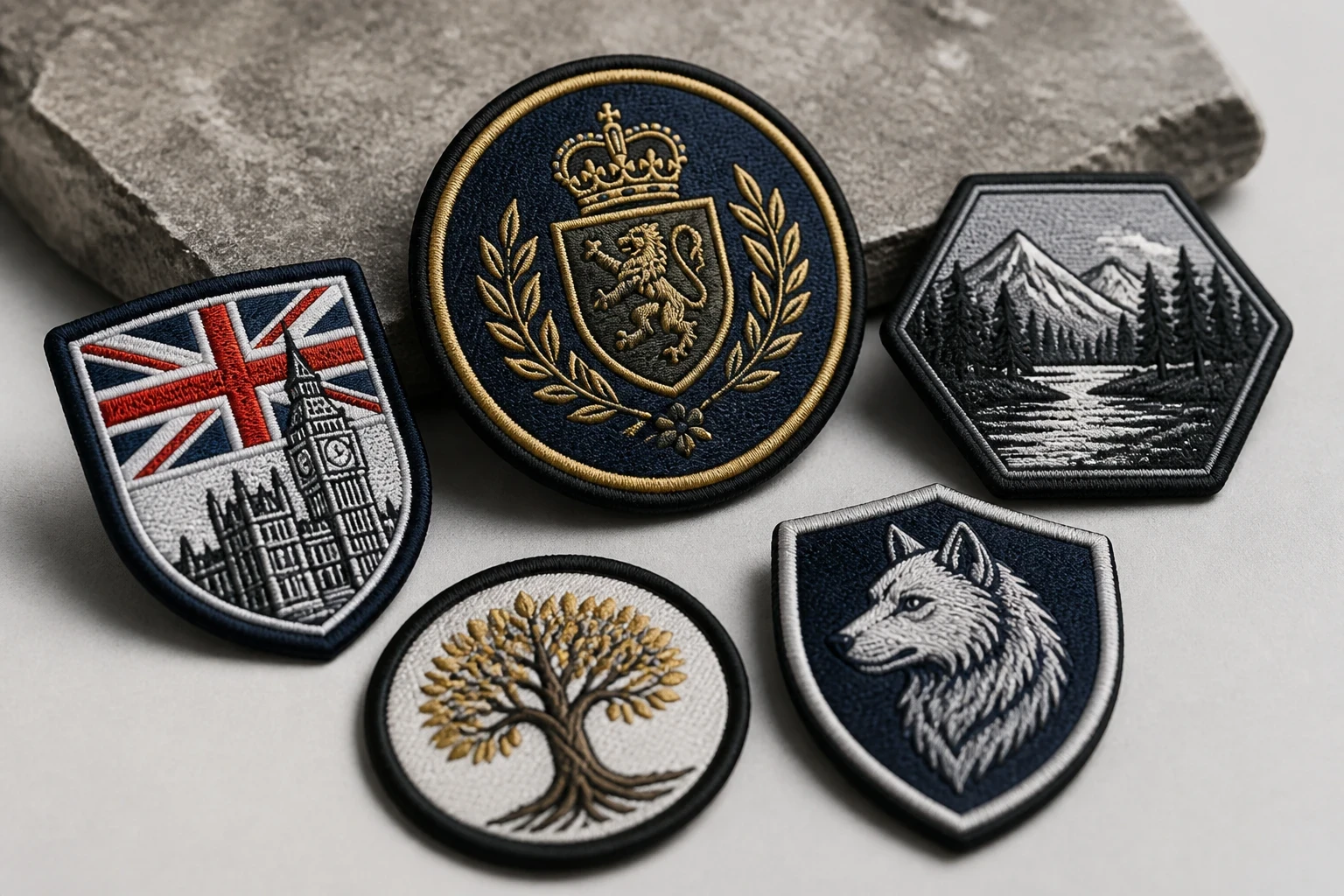
Key takeaways
- Fine-detail woven patches are suited to small text, narrow outlines and logos with several colour areas.
- A patch only strengthens a brand when its size, border, backing and garment placement suit the actual use.
- Printed patches are flatter, while embroidered patches offer more texture; neither is automatically right for every logo.
- The Customized Patches has a 5-piece minimum per design and sends a free digital mockup usually within 12 hours before production.
Fine-detail woven patches UK can strengthen a brand identity by putting a clear, repeatable badge on the garments and kit people actually use. The woven construction keeps small lettering and narrow logo lines more legible than a heavily raised stitch on many compact designs, helping a club crest, business mark or team emblem look consistent from one item to the next.
The best result is not simply the most detailed patch possible. It is the patch that remains recognisable at its working size, suits the garment, and survives the way that garment is worn and washed. The Customized Patches supplies a 5-piece minimum per design, sends a free digital mockup usually within 12 hours, and produces only after approval.
Why fine-detail woven patches UK work for brand identity
A logo has a job beyond looking attractive on a screen. It needs to identify a football club across a changing room, make a hospitality team look joined-up, or help a small clothing label be recognised at a market. A patch turns that mark into a physical sign people see on a sleeve, chest, bag or jacket.
Woven patches use tightly formed threads to create a relatively flat image. That gives the surface a cleaner appearance for small text, thin borders, map-like line work and logos with several separate details. On a patch around 2.5 to 3.5 inches wide, this can make the difference between readable wording and a dark line that looks like a blur.
Consistency matters as much as detail. If one batch has a different shape, border or colour balance from another, the garments stop looking like part of the same range. Ordering from approved artwork and keeping the size and backing recorded gives a club, business or brand a repeatable visual asset.
The details that build recognition
- A consistent outer shape makes a badge easier to recognise at a distance.
- A defined border separates the logo from a dark, pale or patterned garment.
- Stable thread colours help shirts, jackets and merchandise look like one collection.
- Correctly spaced lettering is more useful than squeezing every word into a small patch.
- A backing chosen for the garment prevents a neat logo from being let down by poor attachment.
This is also why a patch should be considered as part of the wider identity system. A business might use the same mark on polos, work jackets and equipment bags. A cadet unit may need a formal crest on uniform and a simpler morale patch for outdoor kit. The artwork can be related without every application using exactly the same construction.
Choosing the right construction for a detailed logo
Woven is often the sensible starting point for a logo with small lettering or many compact shapes, but it is not a universal answer. Raised embroidery adds texture and a premium stitched feel. Printed is flatter; that is the point. It can suit gradients, very fine artwork and a design that must look almost like a printed label.
For a thick varsity letter or a large club initial, embroidered patches may provide the surface and height people expect. A soft, bold collegiate design may be better suited to chenille patches, while a hard-wearing equipment badge may call for PVC patches. The decision should follow the artwork and use, not a general claim that one material is best.
| Patch type | Best suited to | Main visual quality | Trade-off to consider |
|---|---|---|---|
| Fine-detail woven | Small lettering, compact logos, line work and detailed crests | Flat, clean and controlled detail | Less raised texture than embroidery |
| Embroidered | Bold logos, traditional crests and designs where texture is part of the look | Visible stitch depth and a familiar badge finish | Tiny gaps and small text may close up at compact sizes |
| Printed | Gradients, photographic-style artwork and very fine continuous lines | Flat image with broad artwork freedom | Does not provide the tactile thread surface of woven or embroidered patches |
| PVC | Outdoor kit, workwear, bags and designs needing a wipe-clean surface | Raised rubber-like shapes and clear separation | Fine visual detail may need to be simplified into moulded areas |
| Leather | Minimal marks, heritage products and premium lifestyle goods | Natural material character and restrained branding | Not the usual choice for colourful, highly detailed artwork |
The table is a starting point rather than a substitute for checking the actual artwork. A detailed crest may have a large outer symbol but tiny internal wording. A patch maker can assess those two parts separately and advise whether the whole design should be woven, simplified, printed or split into different applications. Our woven patches guide also covers common uses and construction choices.
For a genuinely complex logo, ask to see the design at the intended finished size. A large digital file can make every line look perfect, but a 2-inch badge has physical limits. The useful question is not whether the artwork can be displayed on a monitor; it is whether the key parts still read on the garment from normal viewing distance.
Designing a patch that remains recognisable
The design stage is where most preventable problems can be removed. Start by deciding what the viewer must notice first: the brand name, club initials, animal mark, service name or a particular symbol. Secondary details should support that priority rather than compete with it.
Small text is a frequent source of disappointment. A team may send a crest containing its founding year, a long motto and a detailed shield, all intended for a 2-inch chest patch. Some of that information may need to be removed, enlarged or moved to a second design. A smaller amount of clear information usually represents the organisation better than a complete but unreadable copy.
Artwork checks before a quote
- Measure the available area on the actual garment rather than estimating from a screen.
- Mark the words or symbols that must remain exactly as supplied.
- Check whether thin outlines have enough space around them to remain separate.
- Avoid placing similar dark colours next to one another without a border or contrast.
- Decide whether the edge is straight cut, merrowed or another shaped finish.
- Supply the cleanest available artwork and mention any required brand colours.
- Ask for the mockup at finished size, not only as a large artwork file.
A merrowed crest can look right on a traditional sports jacket, but the rounded stitched edge adds visual weight around the outside. A straight-cut or laser-cut edge may suit a modern label with angular artwork. Neither edge is automatically more professional; it depends on the shape and the garment.
Colour needs practical attention too. Thread and ink are not viewed against a blank artboard once the patch is made. A navy badge on a black nylon shell may lose its outer distinction, while a pale border on a white polo may disappear. The mockup should show the intended colour relationship and the border should be judged against the garment colour.
The same principle applies to negative space. A narrow gap between two letters can close during production or become difficult to see after normal wear. Leaving a little more space may appear less faithful to the original vector file, but it often produces a clearer physical badge.
Not sure whether woven, embroidered or printed will hold your logo best? Send the artwork and intended garment for a free digital mockup usually within 12 hours, so you can compare the result before production.
GET A FREE MOCKUPMatching the patch to real UK garments
A patch on a smooth polo behaves differently from one on a thick wool coach jacket. Before choosing a backing, tell the manufacturer what the patch will touch and how the garment will be used. Typical enquiries cover patches for nylon shells, school blazers, hospitality polos, football jackets, biker vests and work bags; the surface changes the sensible recommendation.
Nylon shells can be slippery and heat-sensitive, so an iron-on option needs more care than it would on a cotton sweatshirt. A wool coach jacket may need a sew-on patch because heat and pressure can mark the fabric. A school blazer normally benefits from secure stitching, especially if the garment will be brushed, washed and passed between school terms.
Backing choices in plain terms
| Backing | Useful for | What to check |
|---|---|---|
| Sew-on | Blazers, wool jackets, biker vests, uniforms and items expected to be washed regularly | Allow time for stitching and check the edge can be reached with a needle |
| Iron-on | Suitable cotton garments and straightforward one-off fitting where heat can be controlled | Confirm the fabric can take heat; an iron-on patch that peels after a dryer cycle is not a successful application |
| Hook-and-loop | Removable morale patches, tactical kit, Velcro panels and changing team identifiers | Specify whether the hook or loop side is required and check the panel dimensions |
| Adhesive | Temporary display, sampling or selected smooth surfaces | Treat it as application-specific rather than assuming it will replace sewing on every garment |
Iron-on backing is convenient, but convenience does not remove fabric limitations. A patch applied to a jacket may look secure on day one and then lift at the corners after heat, moisture and repeated movement. If a garment will see hard use, washing or outdoor weather, sew-on or hook-and-loop may be the safer choice.
For biker and motorcycle club clothing, placement is part of the identity. A back panel may need a large central design, while a small front or sleeve mark can identify a role or chapter. See the guide to biker and motorcycle club patches for more context on layouts, sizing and garment use.
Using one patch system across a growing brand
A new business may begin with five patches for a small uniform order and later need several dozen for staff, events or resale. Starting with a recorded size, border, colours and backing makes repeat orders easier to manage. The design remains a useful brand asset rather than a one-off decoration.
Clubs often need several applications at once. A football club might use an embroidered crest on matchwear, woven name patches on training jackets and a printed patch for a sponsor-led event. A hospitality business could use a fine-detail woven logo on outerwear while keeping a flatter printed version for lightweight shirts. Different patch types can still belong to one identity system if colour and proportions are controlled.
- Keep one approved master logo and identify any simplified patch version clearly.
- Record finished dimensions in inches for every application.
- Keep a note of the backing used on each garment type.
- Use the same important brand colours where the chosen material allows it.
- Order spare pieces if staff changes, replacements or future additions are likely.
- Do not alter the border or lettering between batches without approving a new mockup.
The 5-piece minimum per design is useful for small organisations testing a new garment or preparing a first club order. It also lets a brand produce a modest sample run without committing to a large stock quantity. If several colourways are needed, treat each distinct design as its own quantity when planning the order.
Brands selling clothing should think about the customer experience as well as the patch itself. A badge sewn to a heavy overshirt has a different feel from one fitted to a cap or canvas bag. The product should look intentional on the item, and the patch should not make the garment awkward to clean, fold or wear.
Ordering detail, quantities and approval
A useful quote includes more than a logo file. Send the approximate finished size, quantity per design, garment type, preferred backing, border preference and delivery postcode in the United Kingdom. If the patch is part of a larger uniform order, explain the number of garments and whether spares are required.
The Customized Patches has a 5-piece minimum per design. A design means the specific artwork and specification being produced, so changing the shape, colours or wording may create a separate version. Clarifying this before payment avoids a shortfall when a team has counted several variants together.
What happens before production
- You send artwork and the practical details of the order.
- The production team reviews the design against the requested size and material.
- A free digital mockup is usually supplied within 12 hours.
- You check the artwork, dimensions, colours, border, backing and garment context.
- You request any changes before confirming the final version.
- Production starts only after approval.
The mockup is the point to query anything that feels too small, too crowded or poorly contrasted. Ask to see the correct backing and mention if the patch will sit on a curved sleeve, a Velcro panel or a thick seam. A small clarification at this stage is easier than changing finished patches.
Lead time depends on the specification, quantity, artwork approval and production schedule. It is sensible to leave room for your own review, delivery across the UK and fitting the patches to garments. If a club has a fixed tournament date or a business has a uniform launch, state that date with the first quote rather than assuming it can be met later.
UK-wide shipping can be arranged as part of the order discussion. Delivery is separate from production time, so allow for both. If you need patches sent to several sites, such as a club office and a kit supplier, mention this before the quote is finalised.
Common failures that weaken a brand badge
Most poor results are specification problems, not mysterious manufacturing faults. The logo may have been too small, the backing may not suit the fabric, or a colour may have been selected without considering the garment. These issues are avoidable when the patch is treated as a product specification.
Name sew-on, iron-on or Velcro on the quote and tell us which garment will carry the patch. We show the correct backing on a free digital mockup usually within 12 hours, and production starts only after you approve it.
GET A FREE MOCKUP- Using a full, highly detailed crest at a size intended for a simple icon.
- Assuming an iron-on backing will stay fixed through every wash and dryer cycle.
- Putting dark navy thread on a black shell without a contrasting border.
- Choosing a merrowed edge for a shape that needs a sharp, angular outline.
- Approving a large artwork preview without checking the finished dimensions.
- Counting different colourways as one design when planning the 5-piece minimum.
- Leaving no allowance for the patch edge near a zip, seam or pocket.
- Using a temporary adhesive solution on a garment intended for repeated hard wear.
A familiar example is the iron-on that peels after a dryer cycle. The patch may have been made correctly, but the application method and care routine were wrong for that garment. A sewn patch might take longer to fit, yet protect the brand presentation over a much longer period.
Another common issue is trying to make a small badge carry every piece of the organisation's history. If the founding year, slogan, branch name and detailed central symbol all compete in a 2-inch area, the viewer sees visual noise. A simplified secondary mark often works better for everyday clothing, while the complete crest can remain for larger banners or formal use.
A practical decision for teams, clubs and businesses
Choose fine-detail woven patches UK when the identity depends on a clear, compact logo and a relatively flat finish. They are a strong option for hospitality polos, school and cadet garments, branded overshirts, club kit bags, labels and merchandise where small details need to stay controlled.
Choose embroidery when raised thread and traditional badge texture are central to the look. Choose printed construction when a flat image, gradient or very fine continuous line is more important than stitched texture. Choose PVC for selected outdoor or wipe-clean uses, and leather for a restrained material-led mark. The right answer can differ between two garments carrying the same brand.
A good order therefore starts with the identity goal and ends with the application details. Decide what must be recognised, select a construction that can reproduce it, size the patch for the garment, choose a backing that suits the fabric, and approve a realistic mockup. That sequence gives the logo a better chance of looking intentional in daily use.
For a broader comparison, read The Difference Between fine-detail woven patches UK and embroidered patches, Explained. If your artwork is still being prepared, the guide to How to Design Artwork for fine-detail woven patches UK That Production-Ready covers the checks that make quoting easier.
Further reading and product choices
If your brand uses several materials, compare the product hubs rather than forcing every application into one patch type. The printed patches range may suit a flat artwork-led badge, while 3D embroidered patches add height for a bold emblem. A heritage clothing label may prefer leather patches for a simpler mark.
For location-specific ordering questions, the UK city pages provide a useful route to discuss delivery and project details from different parts of the United Kingdom. The production basics remain the same: 5 pieces minimum per design, a free digital mockup usually within 12 hours, and production only after approval.
You can also read How woven patches Can Strengthen Your Brand Identity for a wider overview, or use Woven patches Sizing and Backing Options Explained before sending a quote request.
Frequently asked questions
What are fine-detail woven patches UK used for?
Fine-detail woven patches UK are used for compact logos, small lettering, club crests, uniform badges, branded outerwear, bags and merchandise. They are particularly useful when a relatively flat surface and controlled line work matter more than raised stitch texture.
Are woven patches better than embroidered patches for detailed logos?
Woven patches can reproduce small lettering and close line work more clearly at compact sizes, while embroidered patches provide more raised texture and a traditional stitched appearance. The better choice depends on the artwork, finished size, garment and desired surface. A mockup should be checked before production.
What is the minimum order for fine-detail woven patches UK?
The Customized Patches has a minimum of 5 pieces per design. Different artwork, wording, colourways or specifications may count as separate designs, so include every version when requesting a quote.
How quickly can I see a patch mockup in the UK?
The Customized Patches provides a free digital mockup usually within 12 hours. The mockup should be checked for size, lettering, colours, border, backing and garment use. Production starts only after the artwork has been approved.
Which backing should I use on a nylon jacket or wool coach jacket?
Sew-on backing is often the safer choice for wool coach jackets and garments subject to regular wear. Nylon shells can be sensitive to heat, so iron-on backing should only be used after checking the fabric and application method. Hook-and-loop is suitable for compatible Velcro panels where patches need to be removed.
Can fine-detail woven patches be used for school, cadet or football uniforms?
Yes. They can suit school blazers, cadet clothing, football jackets, training kit bags and other uniform applications when the size, border and backing are selected for the garment. For hard-wearing items, sew-on attachment may be preferable to relying only on iron-on adhesive.
Ready to produce custom patches for your UK team or brand?
GET A FREE MOCKUP