Custom embroidered patches UK for Small Businesses: A Practical Guide
Custom embroidered patches UK give small businesses a durable, tactile way to add a logo or team mark to uniforms, jackets, bags and workwear. The Customized Patches accepts a minimum of 5 pieces per design, supplies UK-wide, and usually provides a free digital mockup within 12 hours. Production starts only after approval.
Key takeaways
- A 5-piece minimum per design makes embroidered patches practical for small UK businesses testing a new uniform or product range.
- Small lettering and fine artwork need checking at the finished size; a digital mockup helps identify problems before production.
- Sew-on, iron-on and Velcro backings suit different garments, washing routines and replacement needs.
- The Customized Patches usually sends a free digital mockup within 12 hours and produces only after the customer approves it.
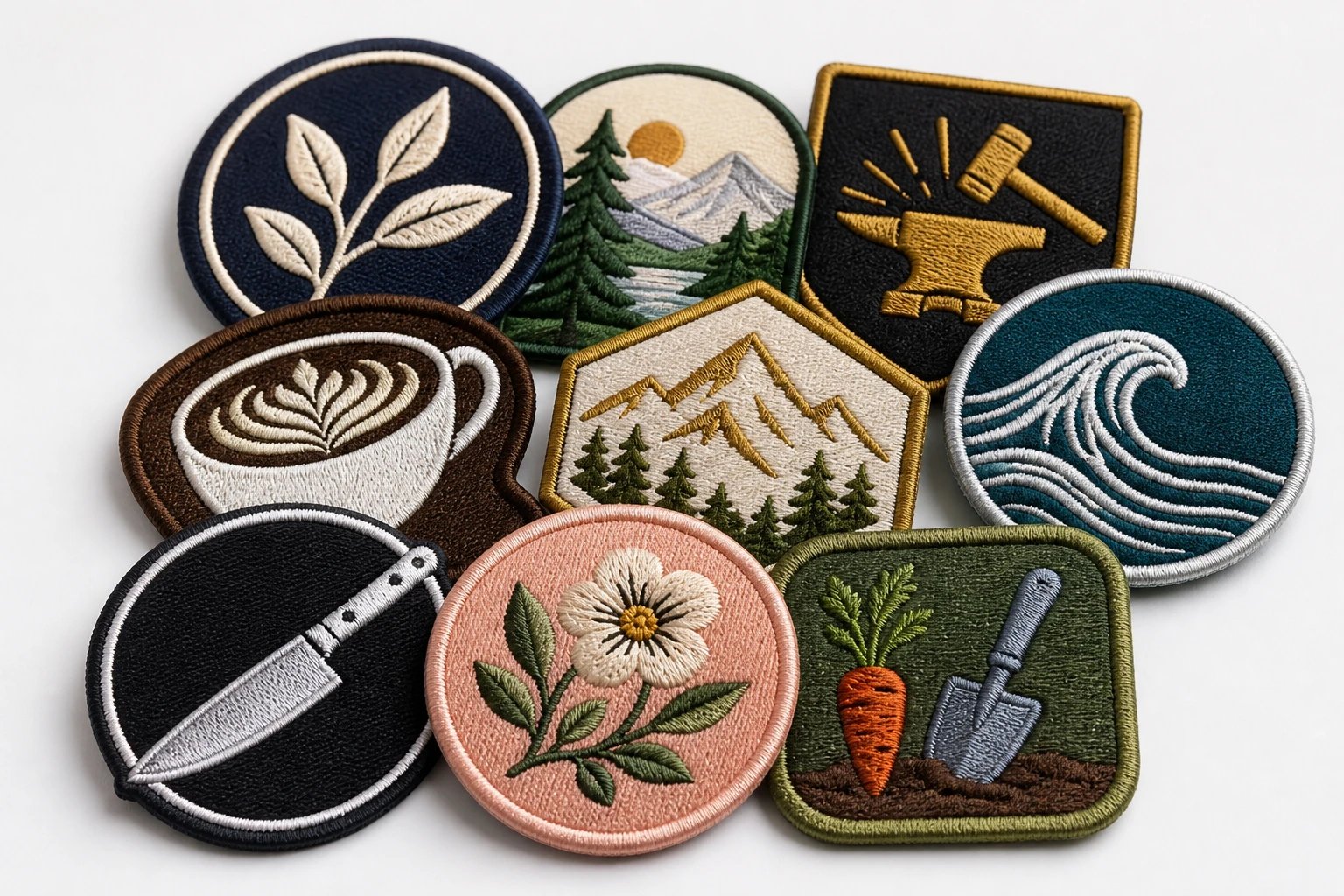
Custom embroidered patches UK are a practical choice for small businesses that need branded uniforms, work jackets, bags or promotional clothing without ordering hundreds of units. They add stitched texture and a clear visual mark, and they can be made for small runs from 5 pieces per design.
The Customized Patches serves customers across the United Kingdom with UK-wide shipping. You can send your logo, explain the garment and quantity, then receive a free digital mockup usually within 12 hours. Production starts only after you approve the design.
Why small businesses use embroidered patches
A patch gives a small company more flexibility than ordering a fully embroidered garment. A café can put the same crest on aprons, overshirts and staff jackets. A landscaping business can use one badge on fleece gilets and a hard-wearing outer coat. A streetwear label can sew the same mark onto caps, tote bags and wool coaches.
That flexibility matters when a team is growing. Staff sizes change, new garments arrive and a logo may be revised. Patches can be ordered separately from clothing, so you do not need to replace every polo shirt just because one member joins or a jacket wears out.
Small businesses also use patches as a product rather than only as uniform branding. A brewery might make a limited-run badge for a taproom event. A barber may add a woven or embroidered mark to retail caps. A cycling club can use a crest on kit bags and casual jackets. The right construction depends on the artwork and the surface.
Embroidered, woven, printed or PVC: which patch suits the job?
Traditional embroidery works well when the design benefits from visible thread and a raised surface. It suits bold logos, simple crests, initials and strong colour blocks. It is not the best answer for every logo. Small paragraphs of text, photographic shading and very fine gradients often need a flatter method.
Printed is flatter; that is the point. A printed patch can show fine lines, tonal artwork and detailed illustrations that would be difficult to reproduce with thread. Woven patches use a tighter yarn structure for smaller lettering and sharper edges, while PVC gives a rubber-like finish that suits outdoor equipment and work bags.
| Patch type | Best for | Main limitation | Typical small-business use |
|---|---|---|---|
| Embroidered | Bold logos, crests, initials and visible thread texture | Fine detail and very small text may need simplifying | Uniforms, jackets, sports clubs and branded workwear |
| Woven | Small lettering, compact symbols and a flatter fabric finish | Less raised texture than embroidery | Caps, labels, fashion pieces and detailed badges |
| Printed | Illustrations, gradients, photographs and fine lines | The surface does not have the raised thread effect | Art-led merchandise, event badges and detailed logos |
| PVC | Water-resistant equipment, bold shapes and outdoor use | Rubber-like appearance may not suit a traditional brand | Work bags, outdoor clothing, security-style kit and equipment |
| Chenille | Large varsity lettering and soft, high-pile designs | Not ideal for very fine detail or compact logos | Sportswear, college-style garments and club jackets |
If your mark has tiny text, ask for a comparison before deciding. The difference between custom embroidered patches UK and printed patches is often easiest to understand when the same artwork is shown at its finished size. The woven patches and printed patches hubs also help if embroidery is not the right surface.
The five-piece minimum
The Customized Patches has a minimum order of 5 pieces per design. That suits a founder who needs five staff badges, a small club ordering its first run, or a brand testing a patch before adding it to a larger collection. If you need two different designs, the quantity applies to each design rather than being treated as one mixed total.
For larger teams, it is worth pricing 25, 50, 100 or more pieces as a separate quantity. The per-patch cost can change with volume, but the best quantity is the one that matches your real use. Ordering a large box of badges that sit in a cupboard is not a saving.
Choose a finished size that works on the garment
Patch size is usually discussed in inches, and the correct measurement depends on the available panel rather than the logo file alone. A small left-chest badge may be around 3 to 4 inches wide. A back-of-jacket crest may be 8 to 12 inches wide. A sleeve or cap badge needs a different proportion and often less text.
Measure the usable area with a ruler. Leave room around seams, pockets, zips and curved edges. A patch that technically fits a sleeve can still look awkward if its border catches the arm seam. For a cap, check the curve and the front panel height before choosing a wide rectangular shape.
Text, borders and small details
Lettering is one of the common causes of disappointment. A slogan that looks clear on a laptop may become a row of thread at 2.5 inches wide. Short words, initials and bold typefaces are safer. If the logo contains a long strapline, consider removing it from the patch and using the business name elsewhere on the garment.
A merrowed crest has a raised, wrapped edge that gives a traditional badge appearance. It works especially well around shield shapes, round club marks and classic uniform designs. A laser-cut or clean-cut edge can suit more angular artwork. The border is not a small afterthought: it affects the overall width, the visual weight and how the patch sits against the cloth.
The sizing and backing guide explains how proportions change across jackets, bags, caps and uniforms. The production-ready artwork guide is useful if your original logo contains gradients, tiny lines or several near-identical colours.
Backing options for workwear, uniforms and products
Backing should be selected with the garment and washing routine in mind. Sew-on patches are the safest general choice for jackets, thick workwear and items that will be washed often. They can be stitched around the edge or through suitable areas of the patch, and they are easier to trust on fabrics that do not tolerate direct heat.
Iron-on backing is convenient on compatible cotton and polyester garments. It can be useful for a small batch of event clothing, but it is not a cure for every garment. Nylon shells, coated fabrics, waterproof jackets and heat-sensitive materials may not accept an iron-on bond. An iron-on patch that looks fine on day one can peel after a dryer cycle if the heat, fabric or application was wrong.
Velcro is useful when the same badge needs to move between garments or be removed for washing. It is common on tactical-style jackets, club equipment and removable role badges. It adds thickness and requires a matching loop panel, so it may not be suitable for a neat polo shirt or a lightweight apron.
| Backing | Good choice for | Check before ordering | Practical warning |
|---|---|---|---|
| Sew-on | Heavy jackets, wool coaches, uniforms and frequent washing | Available sewing space and edge access | Allow time for stitching and use a suitable needle and thread |
| Iron-on | Heat-safe cotton or polyester clothing and quick application | Fabric temperature rating and care label | Do not assume it will bond to nylon, coated fabric or waterproof shells |
| Velcro | Removable badges, equipment and role changes | Whether the garment has a loop panel or needs one fitted | It adds bulk and can catch on other fabrics |
| Plain adhesive | Temporary display, packaging or short-term use | Expected handling and surface type | Usually not the first choice for repeatedly washed clothing |
A school blazer, wool coaches jacket and nylon shell each behave differently. Tell us the garment type before the backing is finalised. The same logo may need sew-on for a school blazer, iron-on for a suitable cotton hoodie, and Velcro for a removable team shell.
Not sure whether thread, woven yarn or ink will show your logo properly? Send the artwork and garment details for a free digital mockup, usually within 12 hours, so you can compare the proposed result before production.
GET A FREE MOCKUPGarment and use-case examples from the production desk
For football clubs, the crest is usually kept bold enough to survive viewing from the touchline. A small sponsor line may need its own treatment rather than being forced into the crest. Club officials also need to decide if the badge is for shirts, tracksuit tops, kit bags or coaches' jackets, because each item has a different surface and washing pattern.
Cadet units and activity groups often need clear role or unit marks on outerwear and bags. Velcro can be useful where badges change between activities, while sew-on is more suitable for a fixed formal crest. It is worth checking the position against pocket flaps, seams and reflective strips before the artwork is approved.
Hospitality businesses frequently choose left-chest patches for polos, overshirts and aprons. A simple emblem with a readable business name usually works better than a detailed full logo squeezed into a small area. For chefs' jackets or garments washed at high temperatures, ask about stitching and care before selecting iron-on.
Biker vests need a different approach. Large back panels may carry a club name and central emblem, while smaller front patches identify location or membership. Leather and denim accept stitching differently, so check the panel thickness and the border style. See the biker and motorcycle club patches hub for examples of the shapes and placements commonly used.
A small fashion label may prefer a clean woven badge for narrow lettering, while a streetwear collection may want the texture of a heavy embroidered patch. A local tradesperson might choose a bright, high-contrast badge on a fleece jacket. There is no universal best patch; the honest choice comes from the artwork, garment and handling.
Artwork preparation and colour decisions
Send the clearest file available. Vector artwork is helpful because shapes and lettering can be assessed without the blur that appears in a small JPEG. A high-resolution PNG can also be useful. If all you have is a photograph of an existing badge, send that rather than redrawing it yourself and explain what must stay unchanged.
Thread colours are selected to represent the artwork, but a screen colour and a thread colour are not identical. Navy can look almost black in one setting, and two close shades may merge once stitched. Strong contrast helps the badge read on a dark jacket, while a pale border may disappear against a white polo.
Ask to see the border, backing and size on the mockup, not only the artwork floating on a white background. The mockup should help you check spelling, layout, colour relationships and the position of the patch on the garment. If a detail matters to your brand, mention it in the quote rather than hoping it will be inferred from the file.
What to approve before production
- Finished width and height in inches
- Patch shape and border treatment
- Thread, yarn or ink colours
- Spelling, initials and small lettering
- Backing type and any hook-and-loop requirement
- Quantity for each separate design
- Garment type and intended placement
- Delivery details within the United Kingdom
The checklist for UK buyers covers these points in a shorter format. It is worth using before approval because a spelling correction after production is not the same as a spelling correction on a digital proof.
Ordering, quantities and lead times
Start with the use, quantity and deadline. Tell us if the patches are needed for a launch, tournament, staff induction, wedding, trade show or seasonal collection. A clear deadline does not remove production time, but it helps the quote account for the delivery date and any approval changes.
The normal process is straightforward: send the artwork and requirements, receive a quote and mockup, request any changes, then approve the final version. The Customized Patches usually sends the free digital mockup within 12 hours. Production begins only after approval, so late replies or repeated revisions can affect the overall schedule.
A 5-piece minimum applies to each design. For a small business, that can mean five identical badges for a core team or five units of a new product patch. If you have a main logo, a staff role badge and a seasonal badge, list each design separately so the quantity and pricing are clear.
Do not leave the garment information until the end. A patch for a cotton sweatshirt may be simple; one for a coated nylon shell needs a more careful backing decision. If the patch is going onto a school blazer, wool coaches jacket, leather panel or Velcro base, say so in the first message.
What affects the cost of custom embroidered patches UK?
The main cost factors are finished size, patch type, stitch or print coverage, number of colours, backing, border, quantity and any setup required for the artwork. A large full-coverage crest uses more material and production time than a small one-colour name badge. Velcro also involves more components than a standard sew-on finish.
Quantity can change the price per unit, but it should be balanced against likely demand. Five patches may be sensible for a new business with five staff. Fifty may make sense for a club with several squads. A larger run may suit a retail label that has already tested the design, but there is little value in ordering 1,000 before you know the badge sells.
A price comparison is only useful when the specifications match. Ask if the quoted figure includes the chosen backing, border, number of colours, mockup and delivery. The UK cost guide explains why two apparently similar patch quotes can differ.
Common mistakes small businesses can avoid
The first mistake is ordering from a screen image without checking the finished size. Logos are often designed for websites, where fine lines and small text look sharp. A badge has physical limits. Simplifying one line of text can produce a cleaner result than trying to preserve every detail.
The second is selecting iron-on because it sounds easy without checking the garment. Nylon shells, waterproof fabrics, coated bags and some technical clothing can mark, melt or reject the adhesive. A sew-on patch may take longer to fit but can be the more dependable choice.
The third is treating every dark colour as black. Deep navy, bottle green and burgundy can be important to a brand, but they need enough contrast against the garment and border. Ask for the proposed thread colours on the mockup and compare them with the actual uniform under normal lighting.
Name sew-on, iron-on or Velcro on the quote and include the garment material. We show the proposed backing on a free digital mockup, usually within 12 hours, and produce only after you approve the final design.
GET A FREE MOCKUPThe fourth is missing a quantity distinction. Five pieces of one design is not the same as five pieces split across several designs. List the exact design names and quantities. This is particularly useful for businesses ordering a logo patch, a role patch and a location patch together.
The common ordering mistakes guide gives a fuller check before you approve. The 10 questions guide is useful when more than one person needs to sign off the order.
Care, attachment and replacement planning
Follow the garment care label first. For sewn patches, inspect the edge after washing and repair a loose stitch before it catches on equipment. For iron-on patches, avoid assuming that a hot tumble dryer is harmless. Excess heat and repeated flexing can weaken an adhesive bond.
Workwear may be washed more often than casual merchandise. If a team wears the patch five days a week, choose the construction and backing for that routine rather than for the first fitting. Keep a few spare patches for new starters, damaged garments or a replacement after a hard season.
If you are attaching patches yourself, test one on a spare or hidden section of the garment first. This is especially useful for iron-on applications. A test can reveal that the fabric is too delicate, the heat is too high or the patch needs stitching around the edge.
A practical decision guide for your business
Choose embroidered patches when the design is bold, the stitched texture supports the brand and the garment can carry a visible badge. Choose woven when lettering and compact detail matter more than a raised surface. Choose printed when the artwork contains gradients, illustration or fine lines. Choose PVC when the badge needs a moulded, wipe-clean feel.
Then choose the backing. Sew-on is the sensible default for many jackets and frequently washed uniforms. Iron-on can save fitting time on compatible garments. Velcro makes sense when the badge must be moved or replaced. If you are still deciding, send the actual garment information rather than choosing from a product name alone.
For a new brand, start with one clear design at a useful size and order the 5-piece minimum for a real-world test. Fit one to the intended garment, wash it according to the care label and ask the team if the text is readable at normal working distance. That small test can prevent a much larger run of unsuitable patches.
For established teams, keep the approved mockup and specifications with your brand files. Record the finished size, colours, backing, border and supplier details. When you need replacements, the original information reduces the chance of receiving a badge that is almost, but not quite, the same.
Related guides and product options
You can compare the full range through the embroidered patches product hub. If your logo needs a raised, dimensional finish, see 3D embroidered patches. For a soft varsity surface, review chenille patches, and for a natural material option consider leather patches.
The supporting guides cover artwork, backing, comparisons, pricing and ordering in more detail. UK customers can also view the UK city pages for local delivery information while still ordering from a UK-wide patch maker.
- 10 Questions to Ask Before Ordering custom embroidered patches UK
- Custom embroidered patches Sizing and Backing Options Explained
- The Difference Between custom embroidered patches UK and printed patches, Explained
- How to Design Artwork for custom embroidered patches UK That Production-Ready
The best order is not necessarily the biggest or most elaborate one. It is the order with a design that can be read, a backing that suits the garment, a quantity that reflects real demand and a mockup that everyone has approved.
Frequently asked questions
What is the minimum order for custom embroidered patches UK?
The Customized Patches has a minimum order of 5 pieces per design. If you order several different logos, role badges or locations, each design should be listed separately with its own quantity. This makes the quote and production instructions clear.
How quickly will I receive a mockup?
The Customized Patches usually provides a free digital mockup within 12 hours of receiving the artwork and requirements. The timing can depend on the clarity of the brief and any questions about size, backing or garment material. Production starts only after the mockup is approved.
Are embroidered patches suitable for nylon jackets?
They can be suitable, but the backing needs care. Nylon shells and coated waterproof fabrics may not accept iron-on adhesive safely, so sew-on or another specified attachment can be more appropriate. Send the garment details before the backing is chosen.
Should a small business choose sew-on or iron-on patches?
Sew-on is usually the safer choice for heavy jackets, wool coaches jackets and garments washed frequently. Iron-on can be convenient for compatible cotton or polyester clothing, but it may peel after heat or a dryer cycle if the fabric is unsuitable. The garment care label should guide the decision.
Can I order several patch designs together?
Yes, but the 5-piece minimum applies per design. For example, you can request 5 logo patches, 5 staff role patches and 5 location patches, with each design specified separately. A mockup for each design helps confirm that the proportions and lettering work at the finished size.
How do I choose between embroidered and printed patches for my business logo?
Choose embroidery for bold logos, visible thread and a traditional textured badge. Choose printed patches for gradients, illustrations, photographs or very fine lines where a flatter surface is the better result. The same artwork can be compared in a mockup before you approve production.
Ready to produce custom patches for your UK team or brand?
GET A FREE MOCKUP