
3D embroidered patches Trends to Watch in 2026
The main 3D embroidered patches trends for 2026 are selective raised foam detail, cleaner one-colour crests, heritage shapes, Velcro-backed team badges and smaller brand marks designed for caps and outerwear. The best result still depends on readable artwork, suitable backing and the garment. The Customized Patches supplies a free digital mockup, usually within 12 hours, with a five-piece minimum per design.
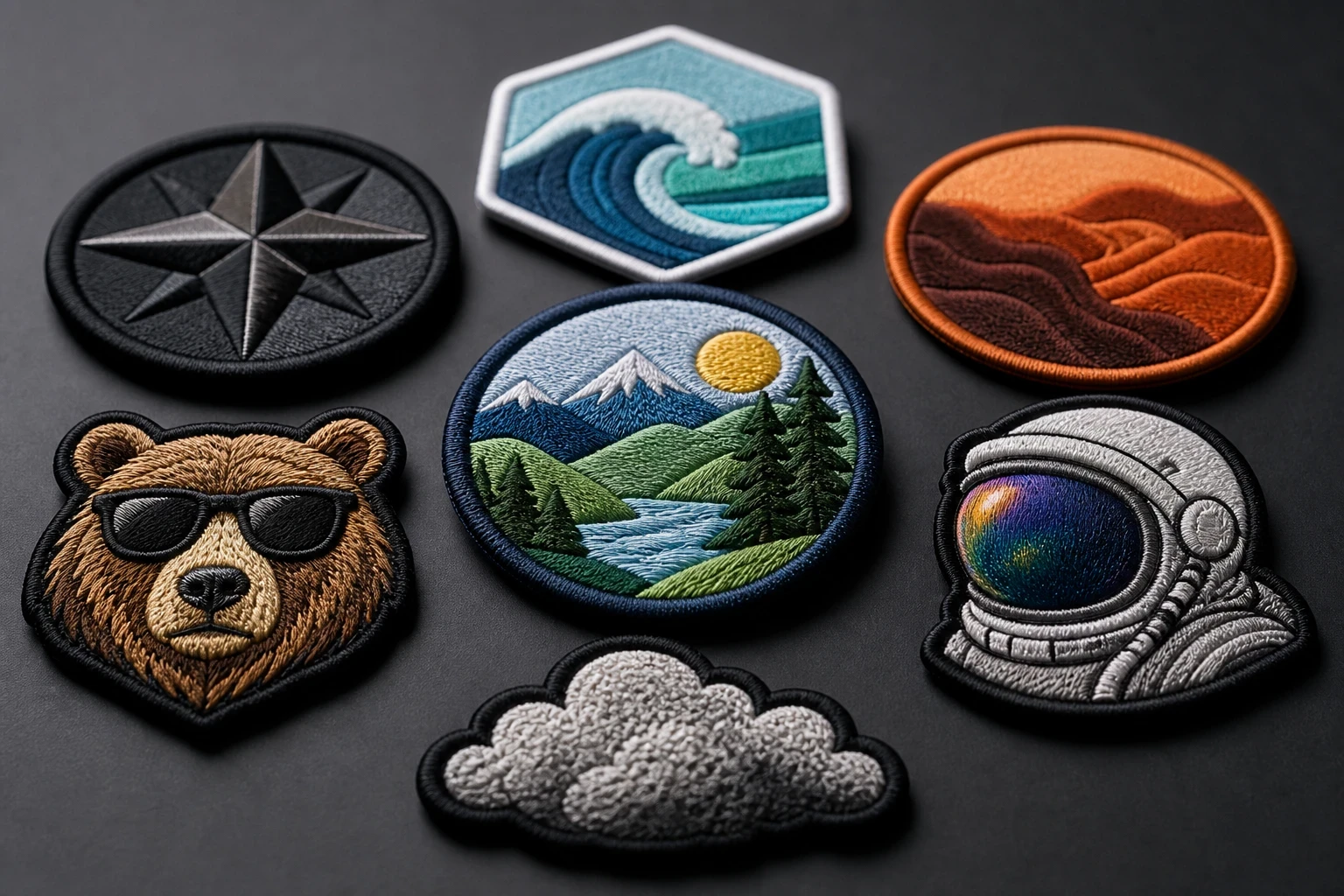
Key takeaways
- Raised foam works best as a controlled feature, not as a treatment applied to every small detail.
- Heritage borders, simple crests and restrained colour palettes are likely to remain useful beyond seasonal fashion.
- Backing must match the garment: sew-on is dependable, iron-on is convenient, and Velcro is best for removable panels.
- The Customized Patches has a five-piece minimum per design and normally provides a free digital mockup within 12 hours before production.
The 3D embroidered patches trends to watch in 2026 are practical rather than purely decorative: controlled raised lettering, compact crests, heritage borders, removable Velcro badges and cleaner designs that still read at a distance. For UK teams, brands, clubs and businesses, the strongest patch is the one that suits the garment and survives the way it will be worn.
The Customized Patches can turn your artwork into a free digital mockup, usually within 12 hours. There is a five-piece minimum per design, and production starts only after you approve the mockup. That approval stage matters, especially with 3D work, because foam height, small lettering, backing and the edge finish all affect the finished badge.
What 3D embroidered patches actually add
A 3D embroidered patch uses foam beneath selected stitched areas so those parts sit above the base fabric. The raised section is normally covered with thread, then the excess foam is removed around the stitching. It gives a logo physical height and a shadow line that flat embroidery cannot create.
That does not make 3D suitable for every design. A football club crest with a broad initial, a hospitality brand with a short wordmark or a biker club emblem with a bold central symbol can work very well. A detailed illustration packed with tiny text usually needs simplifying first. The raised effect cannot rescue artwork that is too small to read.
A common misunderstanding is that customers ask for every line to be raised. Usually, that produces a busy surface and reduces the contrast between the important parts. Printed is flatter; that is the point. Flat embroidery is also the better choice for fine detail, gradients and small text in many cases. Our guide to 3D embroidered patches vs flat embroidered patches: Which Is Right for Your Project? explains the distinction in more detail.
Trend one: selective raised lettering and symbols
The most useful 2026 direction is selective relief. Designers are raising one word, one initial, a mascot feature or the centre of a badge while leaving the border and supporting details flat. This gives the eye a clear focal point and keeps the patch easier to manufacture.
For example, a rugby club might use raised initials across a navy base, with a flat embroidered laurel around them. A streetwear label could raise a short block wordmark and leave its small date line flat. A trades business may raise a simple tool icon rather than trying to lift a full paragraph of service information.
- Raise broad lettering with enough stroke width for the foam and covering stitches.
- Keep fine outlines, tiny dates and small secondary wording flat.
- Use a clear contrast between the raised thread and the base fabric.
- Avoid putting raised foam too close to a narrow merrowed edge.
- Check the design at its actual patch size, not only on a large screen.
This approach also helps with cost control. More raised areas mean more preparation and more careful finishing, while a focused raised feature delivers much of the visual benefit without making the entire design difficult to read. It is a sensible option for a five-piece test run as well as for larger team orders.
Trend two: heritage crests and familiar UK club shapes
Heritage styling continues to make sense because patches already carry a sense of belonging. Shield outlines, round club badges, arched name tabs and old-school varsity lettering work on football jackets, school blazers, wool coaches, denim and workwear. The trend is not about copying an old badge. It is about using a shape people recognise quickly.
This applies to requests from football clubs, cadet units, cycling groups and hospitality teams. A clean border and two or three strong colours often look more convincing than a crowded palette. A merrowed crest can give the edge a traditional finish, although the border needs enough room to avoid closing up around small points and corners.
Why simple borders are doing more work
A border separates the badge from the garment. On a black nylon shell, a bright outer line can stop a dark crest disappearing. On a pale school blazer, a darker merrowed border can make the shape feel finished. The border also frames the raised section, making the height easier to see.
There is a practical limit. Very narrow borders can become uneven, particularly around sharp shield points. If the artwork is still being designed, allow a usable border rather than adding one at the last minute. The Custom embroidered patches UK Sizing and Backing Options Explained guide covers the relationship between patch size, detail and application.
Trend three: compact patches for caps, sleeves and small panels
Large back badges will not disappear, but more buyers are asking for compact 3D embroidered patches for caps, chest panels and sleeves. A patch around 2 to 3 inches wide can work well for a simple symbol or short word. At that size, the design must be edited hard. Fine club mottos and long business names are usually better as a separate flat or woven treatment.
Caps are especially unforgiving. The curved crown can make a stiff patch sit awkwardly, and a deep raised section may catch against the wearer’s head or look oversized. A lower-relief design, rounded shape and sew-on or carefully selected iron-on backing can be more practical than a tall rectangular badge.
| Use | Practical size range | Design approach | Backing to consider |
|---|---|---|---|
| Cap front | 2 to 3 inches wide | One symbol or short word, limited raised detail | Sew-on or suitable iron-on |
| Football jacket chest | 3 to 4 inches wide | Crest, initials or mascot with clear border | Sew-on or iron-on |
| Sleeve or workwear arm | 3 to 4 inches high | Vertical badge or short name tab | Sew-on for repeated washing |
| Back of denim or biker jacket | 8 to 12 inches wide | Large central emblem with supporting text | Sew-on, with placement checked first |
| Removable Velcro panel | 2.5 to 4 inches wide | Bold patch that can be swapped or removed | Hook backing with loop panel on garment |
These are working ranges, not fixed rules. The correct size depends on the garment panel, the viewing distance and the number of words. A 2-inch badge with a single raised initial can be clear; a 2-inch badge containing a full company name, phone number and slogan will not be.
Trend four: restrained colour palettes with one strong contrast
The raised surface already creates visual interest, so many good 2026 designs are using fewer colours. A black base with one bright raised colour, a cream patch with dark green lettering, or a royal blue badge with white relief can look more deliberate than a design using every available shade.
This is useful for brands that need patches to sit beside existing garments. A hospitality group may need the badge to work on black polos, aprons and jackets. A school may need it to sit neatly on a navy blazer. A club may be ordering different garments from different suppliers. A controlled palette gives the patch a better chance of looking consistent.
Thread colour is not the same as screen colour
Artwork supplied on a monitor can look brighter and smoother than thread. A digital blue may appear different once stitched, particularly against a textured base. Colour choice should therefore be judged with the base fabric, border and raised section together. A free mockup helps, but it remains a digital representation rather than a physical sample.
Not sure how much of your logo should be raised? Send the artwork and the intended garment. We will prepare a free digital mockup, usually within 12 hours, so you can compare the proportions before production.
GET A FREE MOCKUPIf colour matching is critical, say so at quotation stage and provide the clearest reference available. Keep in mind that thread has a surface and direction; it is not a flat printed swatch. Our printed patches are often the better fit for photographic detail or smooth colour transitions, while woven patches can suit small fine lettering without a raised surface.
Trend five: removable Velcro-backed badges
Velcro-backed patches are becoming more common for teams and businesses that need to change names, roles or units. The patch carries the hook side, while the garment has a compatible loop panel. This is useful on tactical-style bags, training jackets, event clothing and workwear where the same garment may be used by different people.
The trade-off is that Velcro adds thickness and changes the way the patch sits. It also needs a properly positioned loop panel on the garment. A raised patch can look excellent on a firm panel, but it may feel bulky on a lightweight polo. If a garment has no panel, a sew-on badge is often the more straightforward choice.
- Choose Velcro when the badge needs to be removed, exchanged or stored separately.
- Check the panel size before setting the patch dimensions.
- Allow for the added backing thickness at collars, cuffs and narrow pockets.
- Do not assume a standard iron-on patch can be converted to Velcro after production.
- Test placement on the actual garment if the badge will sit over a seam or pocket.
For biker and motorcycle club patches, a large back badge is usually expected to stay in place, so sew-on remains common. See our guide to biker and motorcycle club patches if the design includes a back panel, rocker text or multiple badge positions.
Trend six: patches designed for real outerwear
Patch design is moving closer to the garment itself. A badge intended for a nylon shell needs different thinking from one intended for a wool coaches jacket or a school blazer. Nylon can be slippery and lightweight. Wool has a nap and can hide a thin edge. A jacket seam, zip or lining may restrict where the patch can be applied.
This is why we ask about the garment before confirming a backing. Iron-on is convenient, but it needs suitable heat, pressure and a compatible fabric. On some nylon shells, high heat can damage the material. On a wool coach jacket, the patch may need sew-on application for a dependable result. Iron-on that peels after a dryer cycle is usually the result of unsuitable fabric, insufficient application or repeated heat, not a reason to ignore the backing decision.
Backing choices in plain terms
| Backing | Best suited to | Main benefit | Watch for |
|---|---|---|---|
| Sew-on | Jackets, denim, wool, uniforms and repeated washing | Secure and broadly compatible | Needs stitching and a little more fitting time |
| Iron-on | Suitable cotton and some uniform fabrics | Quick application without visible stitches | Heat and washing instructions must be followed |
| Velcro | Removable team, event and workwear panels | Patch can be changed or removed | Adds bulk and needs a loop panel |
| Adhesive | Short-term display or light-use projects | Fast temporary positioning | Not the first choice for frequent washing or heavy wear |
The backing is part of the specification, not an afterthought. Name the garment, fabric and expected washing routine on the quote. If the badge is going on a nylon shell, a school blazer, a football jacket or a Velcro panel, the production recommendation may differ.
Trend seven: mixing 3D embroidery with flatter patch methods
Not every 2026 patch needs to be fully 3D. Mixed construction can make more sense: raised initials with a flat border, a woven text tab attached to a larger embroidered emblem, or a printed panel combined with a stitched edge. The aim is to give each part of the artwork the treatment it can handle.
Printed is flatter; that is the point. It can preserve a photograph, small tonal change or fine illustration that would be lost in raised stitching. PVC patches suit a rubberised, wipe-clean appearance, while chenille patches offer a soft, varsity-style pile rather than a detailed raised foam effect. Leather patches can be right for a restrained outdoor or heritage look.
A useful rule is to choose the surface for the information it must carry. Use 3D embroidered patches for impact and tactile lettering. Use woven for small, crisp linework. Use printed for tonal artwork. Use PVC where a smooth, durable rubber-like finish fits the product. These are different tools, not a contest with one universal winner.
What UK buyers should confirm before ordering
A trend is only useful if it can be ordered clearly. Start with the finished width and height in inches, the intended garment and the number of pieces per design. The Customized Patches has a five-piece minimum per design, so a small club can test a new badge without committing to a large run.
Next, identify the part that must stand proud. Is it the wordmark, the mascot’s head, the centre of a shield or one large initial? Mark that in the artwork or explain it in the quote. If everything is raised, the design team may recommend reducing the effect so the patch remains readable.
- Send the clearest artwork available, preferably as a vector file or a high-resolution image.
- State the finished patch size in inches and show where it will sit on the garment.
- Name the garment fabric, including nylon, cotton, wool, denim or a mixed textile.
- Choose sew-on, iron-on, Velcro or another backing based on use rather than appearance alone.
- Confirm the border style, including merrowed or a clean embroidered edge.
- List the colours that matter most and provide brand references where available.
- Review the free digital mockup and request changes before approving production.
- Confirm the quantity, packaging and UK delivery address before the order is released.
A mockup is not a formality. It gives you a chance to spot a word that is too small, a border that is too narrow, a raised section that is too dominant or a patch that will not fit the intended panel. The Customized Patches produces only after approval, so use that stage properly.
Lead times, quantity and the approval stage
Lead time depends on the design, quantity, backing, finishing and the point at which artwork is approved. A simple five-piece badge is not planned in exactly the same way as a large club order with several sizes, separate name tabs and Velcro panels. UK-wide shipping also needs to be considered alongside production, not after it.
The fastest way to avoid delay is to provide one final artwork version and answer the garment questions early. Changes after approval can affect both the schedule and the specification. If a club is ordering before a tournament, or a brand needs patches for a product launch, include the date the patches must be in hand rather than only the date you hope to place the order.
You can request a free digital mockup usually within 12 hours. The mockup is prepared for review, and production starts only after approval. That process protects both sides: you can check the design, while the manufacturing team has an agreed reference for size, colours, raised areas, edge and backing.
Common mistakes behind disappointing 3D patches
The first mistake is treating a large-screen logo as finished patch artwork. A thin line that looks clear at 10 inches may close up at 2.5 inches. Small wording can become a dark bar once stitches and border are added. Simplification is not a loss of identity; it is how the identity survives the reduction.
Name the garment, backing and required quantity on the quote. We will show the correct 3D treatment on a free digital mockup, usually within 12 hours, and produce only after you approve it.
GET A FREE MOCKUPThe second mistake is selecting the backing after the garment has been bought. Iron-on may be chosen because it is quick, then applied to a fabric that cannot take the required heat. A Velcro badge may be ordered for a jacket with no loop panel. A sew-on badge may be expected to sit perfectly on a curved cap without considering the crown shape.
- Using too much raised foam on small lettering.
- Placing a merrowed edge too close to a sharp point.
- Choosing a patch size before measuring the garment panel.
- Ignoring the thickness added by Velcro.
- Assuming a digital colour will look identical to thread.
- Approving a mockup without checking the actual wording.
- Using iron-on on a fabric that needs sew-on application.
- Ordering separate colourways without confirming that each is a separate design.
For a fuller checklist, read Common Mistakes to Avoid When Ordering 3D embroidered patches. If you are still comparing finishes, the 3D embroidered patches: Everything UK Buyers Need to Know guide covers size, backing, artwork and ordering questions in one place.
Which 2026 trend fits your project?
Choose selective raised lettering if your main goal is a bold wordmark or initials. Choose a heritage crest if the patch needs to feel established on a team jacket, school blazer or club garment. Choose a compact badge if it will sit on a cap, sleeve or chest panel. Choose Velcro if the patch has to move between garments or identify changing roles.
Do not choose 3D simply because it is fashionable. A small business with a detailed service logo may be better served by embroidered patches with selected raised detail, or by printed patches if the artwork includes shading. A team may prefer a flat embroidered border around a raised mascot. The right answer is the one that keeps the important part of the design clear on the garment.
The Customized Patches serves customers across the United Kingdom, including teams, brands, clubs, businesses and uniformed groups. If your project is regional, you can also browse our UK city pages for local ordering information while keeping the same production questions in view: size, artwork, backing, quantity and approval.
The practical forecast for 3D embroidered patches in 2026
The strongest trend is restraint. Raised elements will continue to attract attention, but buyers are becoming more selective about where the height belongs. A clean badge with one raised focal point is easier to read, easier to place and more likely to work across several garments.
Heritage shapes and compact patches should remain useful because they solve real placement problems. Velcro will suit organisations that change badges, while sew-on will continue to make sense for hard-wearing jackets and club garments. Colour palettes will stay controlled where patches need to work with existing uniforms and branded clothing.
The production basics will not change with the trend cycle. Artwork still needs to be readable. Backing still needs to suit the fabric. A raised effect still needs enough space. The best order is still one where the customer sees a mockup, checks the garment application and approves the final specification before production begins.
A short decision checklist
- What is the one feature people should notice first?
- Will the patch be viewed from close range or across a pitch, venue or event space?
- Is the garment a cap, nylon shell, wool jacket, polo, blazer, denim jacket or Velcro panel?
- Does the patch need to be permanent or removable?
- Can all lettering still be read at the finished size?
- Is the five-piece minimum per design suitable for the planned quantity?
- Has the free digital mockup been checked and approved before production?
If those questions have clear answers, the 2026 trends become useful choices rather than decoration. Send the artwork, garment details and intended quantity for a quotation, then use the mockup to make the final call.
Frequently asked questions
What are the main 3D embroidered patches trends for 2026?
The main trends are selective raised lettering, compact crests for caps and sleeves, heritage borders, controlled colour palettes, removable Velcro-backed badges and designs created specifically for outerwear. The practical focus is on using raised foam for one clear feature rather than covering every part of the artwork.
Are 3D embroidered patches suitable for football clubs and sports teams?
Yes. They can work well on football jackets, training tops, caps and team bags, especially when the crest or initials have broad shapes and limited small text. For kit that is washed frequently, confirm the garment and backing before ordering. Sew-on or a suitable iron-on option may be preferable depending on the fabric.
How many 3D embroidered patches do I need to order?
The Customized Patches has a five-piece minimum per design. Different sizes, colourways or separate names may be treated as separate designs, so list each version on the quote. A five-piece minimum allows a small club, start-up or team to test a badge before placing a larger order.
Can I see a mockup before ordering 3D embroidered patches?
Yes. The Customized Patches provides a free digital mockup usually within 12 hours. The mockup lets you check the raised area, colours, size, border and backing. Production begins only after you approve the mockup, so raise any changes before approval.
Which backing is best for 3D embroidered patches?
Sew-on is a dependable choice for denim, wool, jackets and garments that receive regular washing. Iron-on is convenient on suitable fabrics but needs correct heat and pressure. Velcro is useful when patches must be removed or exchanged. Nylon shells, caps, school blazers and other specialist garments should be discussed before the backing is confirmed.
Are 3D embroidered patches better than printed patches?
Neither is always better. 3D embroidery adds height and tactile lettering, making it effective for bold initials, crests and symbols. Printed patches are flatter and can preserve photographs, shading, gradients and fine artwork. Printed is flatter; that is the point. The best choice depends on the logo, garment, viewing distance and finish required.
Ready to produce custom patches for your UK team or brand?
GET A FREE MOCKUP