
Fine-detail woven patches UK Best Practices for brands with detailed logos
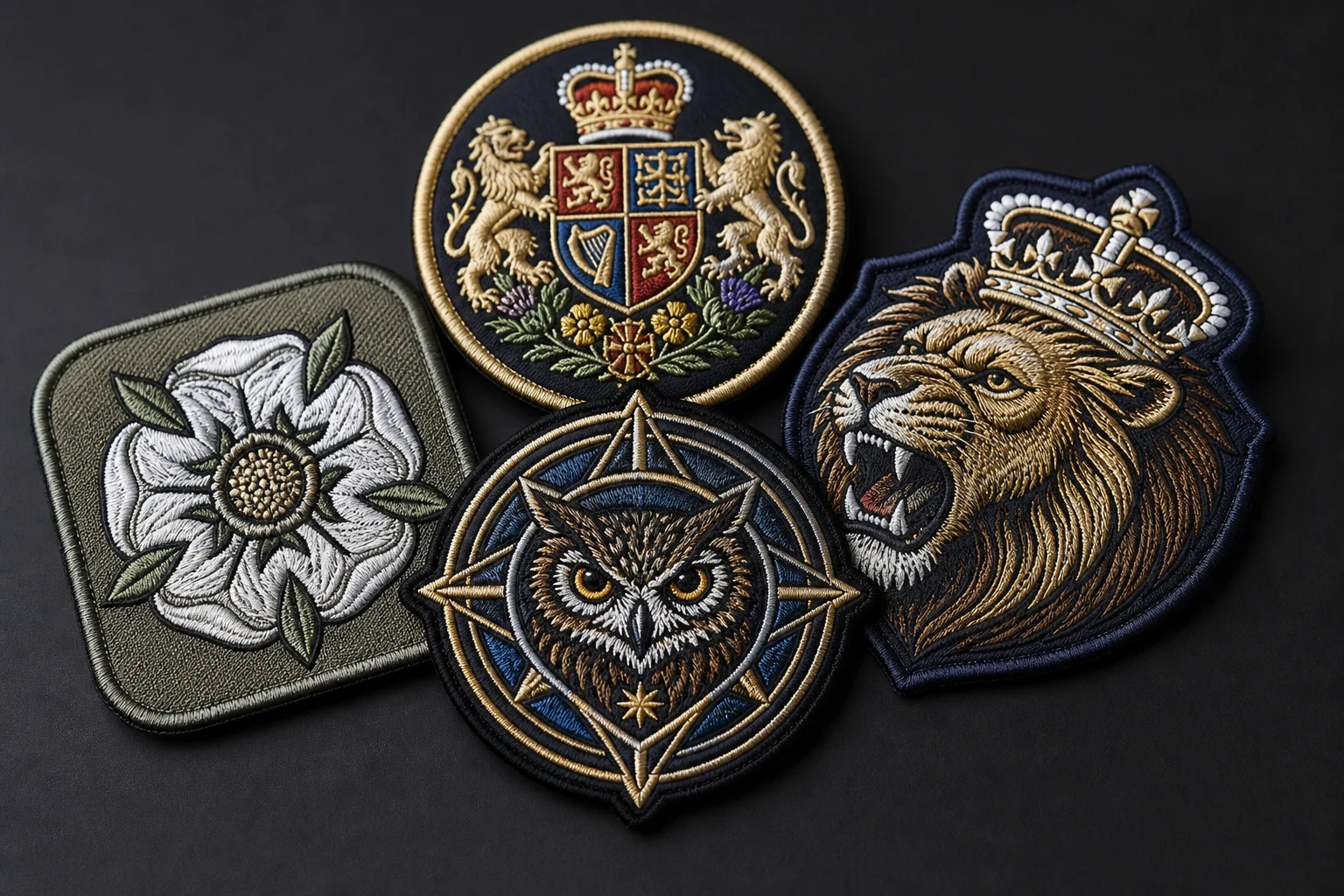
Fine-detail woven patches UK are best suited to brands that need small lettering, clean outlines, gradients or detailed symbols reproduced on a low-profile patch. Use simplified production artwork, check the design at its finished size, choose backing for the garment, and approve a free digital mockup before production. The minimum order is 5 pieces per design.
Key takeaways
- Fine-detail woven patches UK generally suit small lettering, narrow outlines and flat logo artwork better than high-profile embroidery.
- A patch cannot preserve every tiny feature in a logo at every finished size, so artwork must be checked at its actual width and height.
- The Customized Patches has a 5-piece minimum per design and usually provides a free digital mockup within 12 hours.
- Production begins only after the customer approves the mockup, backing, dimensions and design details.
Fine-detail woven patches UK are usually the right choice for detailed logos that include small lettering, narrow lines, several colour areas or a flat graphic style. The woven surface gives a cleaner, lower-profile result than raised embroidery, but the artwork still needs sensible simplification at the finished patch size.
The practical rule is simple: design for the size you will wear, not the size of the logo on a computer screen. The Customized Patches supplies a free digital mockup usually within 12 hours, and production starts only after approval. The minimum order is 5 pieces per design.
Why fine-detail woven patches UK work well for detailed logos
Woven patches use tightly formed threads to create a flatter face. That makes them useful for logos where a raised thread field would crowd the artwork. Small capitals, thin internal lines, compact icons and close colour changes can often be shown more neatly on a woven patch than on a heavily embroidered one.
This is why the request turns up in very different places. A football club may need a sponsor mark on a training jacket. A cadet unit may need a compact shoulder badge with several lines of text. A hospitality company may want its emblem on black polos, while a school may need a blazer badge that stays relatively flat under a coat.
Woven does not mean that every detail can be copied at any size. A 0.02-inch line, a tiny counter inside a letter or a seven-word strapline may merge when the patch is only 2 inches wide. The strongest production result keeps the recognisable parts of the logo and removes details that have no room to exist.
- Choose woven construction for a flatter, cleaner face and compact detail.
- Use a larger patch if the logo includes small text that must remain readable.
- Keep strong contrast between the background and the main logo elements.
- Treat the digital mockup as a production check, not only as a picture for approval.
- Ask for a different construction if the design depends on thick raised texture or a deliberately fuzzy varsity look.
A useful comparison is the difference between a woven crest and an embroidered crest on a football jacket. Woven is often easier to read from a short distance because the surface is flatter. Embroidery has more texture and a traditional stitched appearance, but fine gaps can close when dense thread is used in a small area. The correct choice depends on the logo and the garment rather than on one material being best for every job.
Start with the finished size, not the original logo file
A vector logo may look perfect at 12 inches wide and still fail as a 2.5-inch patch. Before quoting, measure the area on the garment and decide what the wearer should be able to recognise first. For a badge on a school blazer, the school name may matter most. For a clothing brand, the symbol may be more important than a long strapline.
Small lettering and narrow lines
Small text is one of the first areas to test. Condensed fonts, light weights and tightly spaced capitals are especially vulnerable. If the words are essential, increase the patch width, reduce the number of words or use a heavier version of the typeface. Do not rely on a screen zoomed to 200 per cent; inspect a mockup at the approximate size of the finished patch.
Narrow outlines also need attention. A black keyline around a red symbol may look clear in the artwork but become uneven if there is not enough room for it. A wider border, a simpler internal shape or a small colour adjustment can protect the identity of the mark without changing the brand beyond recognition.
Gradients, shadows and very fine detail
Woven patches can represent colour transitions, but gradients are interpreted through available thread colours rather than reproduced like a photographic print. A subtle shadow may need to become a solid darker shape. Tiny highlights may need removing. These edits are not a criticism of the logo; they are the normal translation from screen artwork to stitched material.
If a flat, photographic or illustrated finish is the main objective, compare the brief with printed patches. Printed is flatter; that is the point. If the patch will be exposed to heavy abrasion or needs a rubberised surface, PVC patches may be worth considering. The best production advice is to compare the visual priorities before fixing the material.
| Logo feature | Likely woven-patch treatment | Common risk | Practical adjustment |
|---|---|---|---|
| Small sans-serif wording | Use a heavier, clearer version of the type | Letters merge into the border or one another | Increase patch width or shorten the wording |
| Thin circular outline | Widen the line or make the outline a solid ring | The circle looks broken or uneven | Test the line at finished size in the mockup |
| Soft gradient | Use a small number of related thread colours | The transition looks stepped | Keep the main colour blocks and remove unnecessary shading |
| Tiny internal symbol | Simplify the symbol to its recognisable silhouette | Open spaces close up | Enlarge the patch or remove minor internal marks |
| Photographic face or landscape | Translate into simplified blocks only if suitable | Important detail is lost | Consider a printed patch instead |
| Detailed crest | Retain the key shield, initials and main emblem | The crest becomes visually crowded | Create a simplified patch version approved by the brand owner |
For a fuller material comparison, see Fine-detail woven patches UK vs embroidered patches: Which Is Right for Your Project?. It is also worth reading the guide to How to Design Artwork for woven patches That Production-Ready before sending a logo that contains several layers or effects.
Not sure whether woven, embroidered or printed construction will hold your logo? Send the artwork and garment details for a free digital mockup usually within 12 hours, so you can compare the visual result before production.
Choose dimensions and shape around the garment
The patch should fit the garment without fighting its construction. A chest logo on a polo may need a compact horizontal shape. A shoulder badge on a nylon shell may work better as a rounded rectangle. A biker vest can take a large back panel, but the same artwork may be too wide for a breast pocket or a small Velcro area.
Measure the usable space in inches, not just the overall garment. Check the seam allowance, pocket opening, zip, button line and any existing badge. On a wool coaches jacket, the fabric can look flexible on a table but become taut across a shoulder. On a school blazer, the patch must sit clear of the lapel and pocket stitching.
Borders and merrowed edges
A border gives the design a firm stopping point and helps the logo stand away from the garment. A merrowed edge creates a rounded stitched finish that suits traditional crests and club badges. A heat-cut edge can be cleaner for unusual shapes, small corners and designs where a thick rolled edge would take too much room.
The border is part of the artwork area, so it should not be added as an afterthought. If a 2.5-inch patch has a wide edge, the central logo may have less than 2 inches in which to fit. That difference can decide whether a small word remains readable.
Examples from real garment types
- Nylon shells: check the fabric, lining and heat sensitivity before choosing an iron-on backing. Sew-on is often the safer route for a technical outer layer.
- Wool coaches jackets: allow for the nap and movement of the fabric. A low-profile woven face usually sits more neatly than a very thick embroidered build.
- Velcro panels: specify the hook or loop side required and measure the panel rather than assuming a standard badge size.
- Football training tops: consider stretch, washing and the position of sponsor marks before selecting the patch shape.
- School blazers: keep text legible at arm's length and confirm that the edge will not sit over a pocket seam.
- Biker vests: large back designs can carry more detail, while small front club marks need a simpler version.
If you are still choosing type, size, or backing, send the artwork and the garment. Free digital mockup in 12 hours — 5-piece minimum per design. We do not produce until you approve.
GET A FREE MOCKUPFor motorcycle clothing and club layouts, the biker and motorcycle club patches hub covers larger back pieces, rocker shapes and front chest placements. For raised varsity lettering, compare chenille patches, but remember that chenille texture is a different visual choice from a fine, flat woven logo.
Match the backing to the job
Backing affects fitting, removal and how the patch behaves after washing. Sew-on backing is a dependable choice for jackets, uniforms and garments that may go through repeated use. It takes more time to fit than an adhesive option, but it is not dependent on a glue layer bonding to the fabric.
Iron-on backing is convenient on suitable cotton or stable fabric, particularly for customers fitting a small run themselves. It is not suitable for every nylon shell, waterproof finish or heat-sensitive garment. An iron-on patch that peels after a dryer cycle is a familiar failure, and the problem may be the garment, heat, washing method or insufficient pressure rather than the woven face.
Hook-and-loop backing is useful where a team rotates identifiers or removes a patch before washing. The panel must be the correct size and side, and the patch should not overhang so far that its corners catch on other equipment. If the garment already has a loop panel, send a photograph or measurements with the quote.
| Backing | Best suited to | Advantages | Points to check |
|---|---|---|---|
| Sew-on | Uniforms, jackets, blazers and long-term use | Secure fitting and no reliance on adhesive | Needs stitching around the edge and a suitable needle |
| Iron-on | Suitable cotton and stable garments | Quick fitting for some end users | Heat, fabric finish and washing instructions matter |
| Hook-and-loop | Removable team and equipment patches | Can be changed or removed | Confirm panel size and hook/loop side |
| Adhesive use | Temporary display or short-term placement | Useful for positioning before sewing | Not a substitute for permanent fitting on hard-use garments |
Read Woven patches Sizing and Backing Options Explained alongside the garment information. A quote that says only “woven patch, 3 inches” is incomplete if the final use is a Velcro panel on a rain shell.
Colour, contrast and brand control
A screen colour is not a material specification by itself. If the brand has approved thread references, Pantone guidance or a physical sample, include them. If not, identify the colours by their role: background, primary logo, border, text and highlight. This gives the production team a clear basis for the mockup.
Contrast matters more than the number of colours. Dark blue text on black may be correct in a brand guideline but difficult to read on a small patch. A pale border around a mid-tone symbol can also disappear against a grey jacket. The mockup should be viewed both on a plain background and against the intended garment colour.
Avoiding a crowded colour plan
More colours do not automatically create more detail. They can create small islands that compete with the logo. A disciplined palette of background, main mark, outline and one or two accents often reads better than a near-photographic collection of shades.
For a hospitality polo, a white woven mark on a dark navy background may be clearer than trying to reproduce every shade in a detailed crest. For a club badge, preserving the red and gold identity may matter more than retaining a tiny shadow. These decisions should be agreed before the mockup is approved.
If a badge needs a worn, natural material appearance, leather patches may suit the brief. If the aim is a dimensional letter or thick stitch texture, 3D embroidered patches may be closer. Woven remains the sensible starting point where detail and a relatively flat face are the priority.
The ordering process for a UK business or team
Start with the information that changes the quotation: artwork, finished width and height, quantity, garment type, backing, edge preference and delivery postcode. The Customized Patches serves customers across the United Kingdom, so include the location and the date the patches are needed. A clean brief avoids several rounds of basic questions.
- Send the best available artwork, ideally a vector file, plus a raster preview if the logo contains effects.
- State the intended patch size in inches and explain where it will be fitted.
- Confirm the quantity. The minimum is 5 pieces per design, so different logos should be counted as separate designs.
- Name the backing: sew-on, iron-on or hook-and-loop, and mention the garment material.
- Ask for any specific edge, border, colour or text requirements.
- Review the free digital mockup, usually supplied within 12 hours.
- Request changes if the text, contrast, dimensions or backing are not right.
- Approve the final mockup and quotation before production begins.
The five-piece minimum is useful for a small business trial, a club committee or a single school department that does not need a large run. It also means you can test the design on real garments before committing to a larger quantity. If you need several separate logos, ask for each one to be listed clearly on the quotation.
Lead time depends on the design, quantity, backing, approval timing and delivery arrangements. A detailed logo may need an artwork adjustment before it is ready. That is preferable to producing a patch that technically follows the file but loses the wording or symbol that made the logo identifiable.
Name sew-on, iron-on or Velcro on the quote. The Customized Patches shows the correct backing on a free digital mockup usually within 12 hours, and production starts only after approval. This gives a football club, cadet unit or business a defined point to check before the order moves forward.
Quality checks before approving the mockup
Do not approve only because the general shape looks right. Read every word. Count the main colours. Check the border, corners, backing, dimensions and placement against the garment. If the patch is for a team, ask someone who has not been staring at the artwork all afternoon to read the small text.
- Is the patch width and height shown in inches?
- Does the small wording remain readable at the intended finished size?
- Are the key logo shapes still distinct without zooming in?
- Is there enough contrast between text, border and background?
- Has any gradient or shadow been simplified in a way the brand owner accepts?
- Is the edge suitable for the shape and garment?
- Is the backing correct for sew-on, iron-on or Velcro fitting?
- Does the patch avoid zips, pocket seams, lapels and curved areas?
- Is the quantity at least 5 pieces for each design?
- Has production been held until the final artwork is approved?
Ready to spec the run? Open the quote form for a free 12-hour mockup and UK-wide shipping after approval.
GET A FREE MOCKUPThis check is particularly valuable for a detailed crest. A merrowed edge can look excellent around a traditional badge, but it may take space from a narrow text ring. A heat-cut edge may preserve more of the outer silhouette. Neither option is automatically right; the choice should follow the artwork and the fitting area.
Common mistakes with detailed woven patch orders
The most common mistake is sending a logo and leaving the size to assumption. A brand manager may picture a large back patch while the production brief says a small chest badge. The design then becomes impossible to read at the requested dimensions, even though the original file is technically high quality.
Another mistake is choosing backing after production has been planned. An iron-on option that is fine for a cotton tote may be unsuitable for a coated nylon jacket. A Velcro patch without a matching loop panel is not a complete solution. Give the garment details at the beginning.
Some customers also compare a woven patch with an embroidered patch only by price. The face, height, texture, edge and production requirements differ. Printed is flatter; that is the point, and it may be the better answer for a photographic illustration. For a rounded, raised letter, embroidery or chenille may be more appropriate.
The guide Common Mistakes to Avoid When Ordering fine-detail woven patches UK covers file problems, size assumptions and backing decisions in more detail. The Fine-detail woven patches UK: Everything UK Buyers Need to Know guide is useful if you are still comparing construction, uses and ordering information.
When another patch type may be a better fit
Fine-detail woven patches are a strong option for flat logos, but they are not a universal replacement for every patch construction. A raised sports letter, a soft varsity badge, a rubber equipment marker and a photographic artwork have different requirements. Choosing the wrong surface can make a good logo look wrong on the garment.
| If your priority is... | Consider first | Reason |
|---|---|---|
| Small text and a flat, neat logo | Woven patches | The dense woven face can present compact artwork cleanly |
| Visible raised stitching | Embroidered patches | Thread height is part of the desired appearance |
| A photographic or highly flat illustration | Printed patches | Ink can represent smooth tonal detail more directly |
| Rubberised outdoor or equipment styling | PVC patches | The moulded surface suits a different type of use |
| Soft, thick varsity lettering | Chenille patches | The pile and texture create a bold collegiate appearance |
| Natural hide appearance | Leather patches | The material itself is part of the brand presentation |
You can compare the full embroidered patches range with woven patches before requesting a quote. The useful question is not “Which type is best?” It is “Which surface preserves the important part of this logo on this garment, at this size and with this backing?”
UK ordering advice for brands, clubs and businesses
For a UK brand launch, build the patch approval into the garment approval rather than treating it as a final decoration. A chest patch on a hospitality polo may need to align with embroidery elsewhere. A football club may need the badge to sit beside a sponsor mark. A cadet unit may have several badge sizes for different uniform positions.
Keep one approved master file and one approved patch version. They may not be identical. The master logo can retain fine hairlines and a long strapline for digital use, while the patch artwork can use heavier lettering and fewer internal marks. This prevents an old, unsuitable file being reused for the next order.
For multi-site teams across England, Scotland, Wales and Northern Ireland, record the patch size, backing and placement in the clothing order. UK-wide shipping can be arranged, but a clear internal specification helps every branch fit the same badge consistently. The UK city pages hub can help customers reviewing local service information and delivery coverage.
A detailed logo deserves a practical production decision, not a promise that every pixel will survive. Send the file, state the intended use and inspect the mockup carefully. With the right size, contrast, edge and backing, a woven patch can make a complicated brand mark readable on a real garment rather than merely attractive on a screen.
Frequently asked questions
What are fine-detail woven patches UK best used for?
Fine-detail woven patches UK are best used for flat logos with small lettering, narrow outlines, compact symbols and several colour areas. They suit teamwear, business uniforms, school blazers, club jackets, hospitality polos and Velcro panels where a lower-profile face is preferred. The design still needs checking at its finished size.
What is the minimum order for a detailed woven patch?
The minimum order is 5 pieces per design. If you have three different logos, each logo is normally treated as a separate design. This makes small trials practical for clubs, schools, small businesses and teams that want to test a patch on real garments before ordering more.
How quickly can I see a mockup?
The Customized Patches usually supplies a free digital mockup within 12 hours. Send the artwork, size, quantity, garment type and backing preference to reduce questions and make the mockup more useful. Production starts only after the final design and specification have been approved.
Can a woven patch reproduce very small text?
It can reproduce small text when the finished patch gives the letters enough room, but no patch material can make unlimited detail readable at a tiny size. Increase the patch width, use a heavier typeface, shorten the wording or create a simplified patch version. Always judge the text on the mockup at approximately finished size.
Should I choose sew-on, iron-on or Velcro backing?
Choose sew-on for many uniforms, jackets and long-term use; iron-on for suitable stable garments where heat bonding is appropriate; and hook-and-loop for removable team or equipment patches. Nylon shells, coated fabrics and waterproof garments need particular care. State the garment material and existing panel details when requesting a quote.
Are woven patches better than embroidered patches for detailed logos?
Woven patches are often better for a flatter face, compact lettering and fine graphic detail. Embroidered patches are often better when raised thread texture and a traditional stitched appearance are part of the brief. The right choice depends on the logo, finished size, garment, backing and the visual result you want, not on one material being best in every case.
Ready to produce custom patches for your UK team or brand?
GET A FREE MOCKUP