
Custom Patches for Rugby Clubs in the UK: Playing Kit and Club Merchandise
Rugby club patches should match the garment: a flexible, low-profile crest for playing jerseys, textured embroidery for club jackets, and readable artwork for tour merchandise. Sew-on attachment avoids reliance on heat-sensitive adhesive, but stitching must suit the fabric. Check kit requirements and garment care instructions before approving the design.
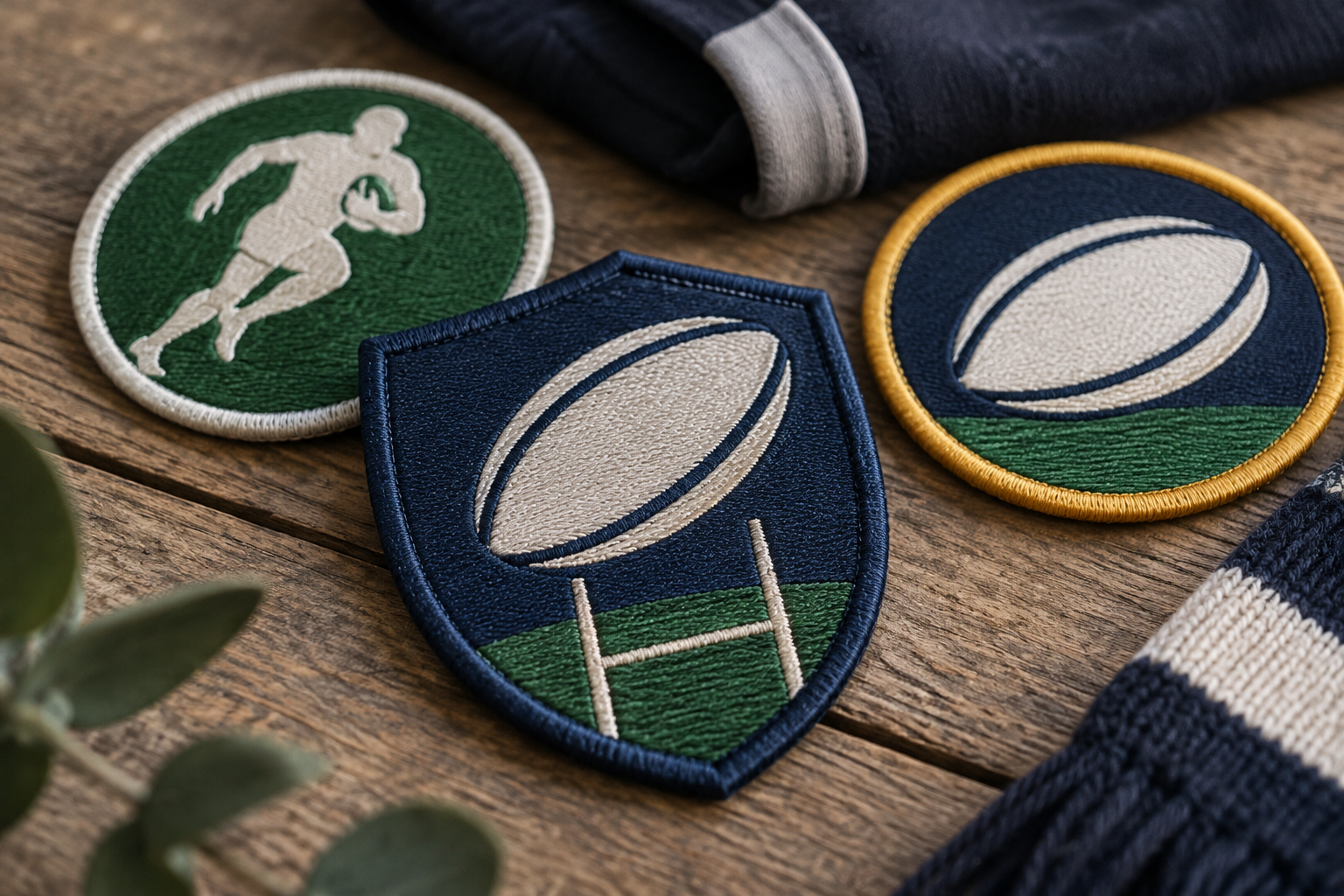
Key takeaways
- Playing jersey patches need low bulk and attachment suited to stretch fabric.
- Sew-on attachment avoids heat adhesive, but poorly matched stitching can pucker or damage sports fabrics.
- Woven patches generally hold smaller lettering than embroidery; printed patches can reproduce gradients.
- The Customized Patches has a 5-piece minimum per design and produces only after artwork approval.
For custom patches for rugby clubs UK-wide, choose a flexible, low-profile crest for playing jerseys and reserve heavier textured badges for jackets and merchandise. Sew-on attachment is a practical starting point for regularly washed kit, provided the fabric and stitching are suitable.
The Customized Patches makes patches to order from your artwork, with a 5-piece minimum per design and free shipping across the United Kingdom. Our free digital mockup is usually ready within 12 hours, and we produce only after approval.
Can you sew a club crest onto a playing jersey?
Yes, but a polyester rugby jersey is not the same sewing job as a cotton polo. Stretch panels move under tension, while a dense patch stretches much less; an unsuitable badge or tight stitching can create puckering and concentrate strain around the edge.
Ask the kit supplier to confirm the proposed placement, embellishment method and any competition requirements before ordering. Avoid seams, ventilation panels and areas that stretch heavily, and check the inside finish for rough stitching against the wearer.
- Keep the crest compact and low-profile, without loose corners or raised decorative elements that could catch during contact.
- Use a sew-on specification rather than assuming an iron-on adhesive will tolerate the jersey's washing routine.
- Have a competent garment decorator choose the needle, thread and stitch settings for the fabric; test attachment on a spare garment where possible.
- If even a lightweight patch restricts the jersey, ask the kit supplier about an integrated printed crest instead.
Specifying custom patches for rugby clubs UK-wide
Choose the patch construction before finalising the size. Embroidered patches give a raised, traditional crest, while woven patches generally accommodate smaller lettering with less surface bulk; printed patches suit gradients and complex colour artwork.
The widths below are suggested starting points, not standard rugby dimensions. Cut a paper outline and place it on the smallest and largest garments, then check that the crest clears seams, sponsor marks and zips.
| Use | Suggested starting width | Construction and attachment | Main trade-off |
|---|---|---|---|
| Playing jersey | 60–75 mm (2.4–3.0 inches) | Low-profile woven or restrained embroidery; sew-on | The patch reduces stretch locally; test placement and stitching. |
| Club jacket or blazer | 75–90 mm (3.0–3.5 inches) | Embroidered crest; sew-on | Raised detail suits firm fabric but adds weight. |
| Tour hoodie or kit bag | 70–90 mm (2.8–3.5 inches) | Embroidered, woven or printed; sew-on | Dates and destinations can crowd a small badge. |
| Canvas cap | 45–60 mm (1.8–2.4 inches) | Simplified embroidered or woven badge; sewn | The curved crown and panel seams limit usable space. |
Send the crest, proposed dimensions and garment details so the specification reflects where it will be worn. We provide a free digital mockup, usually within 12 hours, for approval before production.
GET A FREE MOCKUPKeep the club name readable at actual size
Fine motto lettering and narrow gaps can fill in when translated into embroidery. Simplify the crest, enlarge the badge or compare a woven version rather than shrinking everything to fit; the embroidery versus woven guide explains that choice.
Ask for the border to be shown clearly on the mockup. A merrowed border gives a rounded stitched edge on suitable shapes, but adds bulk; intricate outlines may need a different edge finish to avoid obscuring the design.
Club jacket badges and tour patches need different artwork
A wool blazer or firm cotton club jacket can support a more substantial embroidered crest than a playing jersey. Sew through the intended outer layer rather than accidentally trapping a lining or closing a pocket; a tailor can assess access on a finished garment.
A nylon shell needs more caution: heat can damage the fabric or coating, and stitching creates holes. For waterproof outerwear, consult the garment maker and read Patches on Waterproof Jackets: How to Add One Without Leaks before choosing attachment.
- For tour patches, prioritise the club name, destination and year; keep extra text off a small badge.
- For supporter hoodies, check the badge against both light and dark garment colours.
- For kit bags, use an accessible flat panel and avoid sewing through pockets or waterproof compartments.
- Keep a permanent club crest separate from a dated tour design if you want to reuse the crest on future merchandise.
What survives frequent washing on rugby kit?
Durability depends on the patch, its attachment and the garment's care limits together. Sew-on attachment does not rely on adhesive, but poor stitching can still loosen, cut into a knit or leave edges exposed to snagging.
Iron-on edges can lift after washing or heat exposure if the adhesive, application or fabric is unsuitable. Do not apply extra heat to a polyester jersey to fix lifting without checking its care label; our iron-on versus sew-on comparison covers the practical differences.
Include your required date and quantities for each design so the quote covers the complete requirement. Get a free digital mockup, usually within 12 hours, and check the specification before approving production.
GET A FREE MOCKUP- Follow the most restrictive care instructions for the garment, patch and attachment.
- Turn garments inside out where appropriate, and avoid washing them against exposed hook-and-loop fasteners.
- Avoid tumble drying unless all relevant care instructions permit it.
- Inspect loose threads and lifted edges before the next match; repair attachment rather than pulling at the border.
There is no single safe wash temperature for every patched rugby garment. Use the embroidered patch washing guide alongside the kit label, not instead of it.
How to order: minimums, approval and your fixture date
Our minimum is 5 pieces per design, so a playing crest and a separate tour badge each need their own minimum. Quotes start from £60; request a quote for your actual size, construction, backing and quantity rather than treating that starting figure as a price for every specification.
- Send your artwork through our free mockup quote, with the garment material and intended use.
- Specify width and height in millimetres, quantity per design, colours, edge finish and sew-on or other backing.
- Provide the date the patches must be attached and ready, allowing separately for garment decoration.
- Check the mockup for spelling, dimensions, colours, border and backing, then approve only when the details are correct.
The mockup turnaround is not a manufacturing or delivery promise. Confirm production and delivery timing before committing to a tour or fixture deadline; we produce only after approval, and free UK shipping applies to the patch order.
Frequently asked questions
How do I order custom patches for rugby clubs UK-wide?
Send the artwork, dimensions, quantity per design, garment details and required date through our quote form. The Customized Patches offers free UK shipping and produces only after you approve the digital mockup.
Is embroidery always best for a rugby playing jersey?
No. Embroidery gives a traditional textured crest, but dense stitching adds bulk. Woven patches can suit finer text and a lower-profile finish; check either option against the jersey's stretch and placement.
Can we iron patches onto polyester rugby shirts?
Only if the garment and adhesive instructions permit the required heat and pressure. Polyester sports fabrics and finishes vary. Sew-on attachment avoids application heat, although the stitching still needs to suit the fabric.
Can we split five patches between a club crest and a tour badge?
No. The minimum is 5 pieces per design, not five across unrelated designs. If changing a year, name or colour creates a variation, ask how it will be counted before finalising quantities.
Does the free mockup prove the patch will withstand rugby kit washing?
No. A digital mockup shows the proposed design and specification, not physical wash performance or jersey stretch. Garment compatibility and attachment should be assessed separately, with a test on a spare garment where possible.
Can the same crest work on jerseys and blazers?
The artwork can be shared, but size, construction and attachment may need to differ. A blazer can carry a heavier badge than a stretch jersey; see our rugby blazer and jersey crest guide for those distinctions.
Ready to produce custom patches for your UK team or brand?
GET A FREE MOCKUP