
Patches for Security and Event Staff Uniforms
Security staff patches identify a person's role on a uniform through clear wording, strong colour contrast and visible placement. Use bold, simple lettering, size sleeve badges on the actual garment and choose a backing suited to its fabric. Embroidery suits bold designs; woven patches suit finer detail.
Key takeaways
- Make the role wording larger than the organisation name on identification patches.
- Check sleeve badges at actual size on the smallest garment in the uniform range.
- Ordinary white or yellow thread is not a substitute for reflective material.
- The minimum is 5 pieces per design; production starts only after approval.
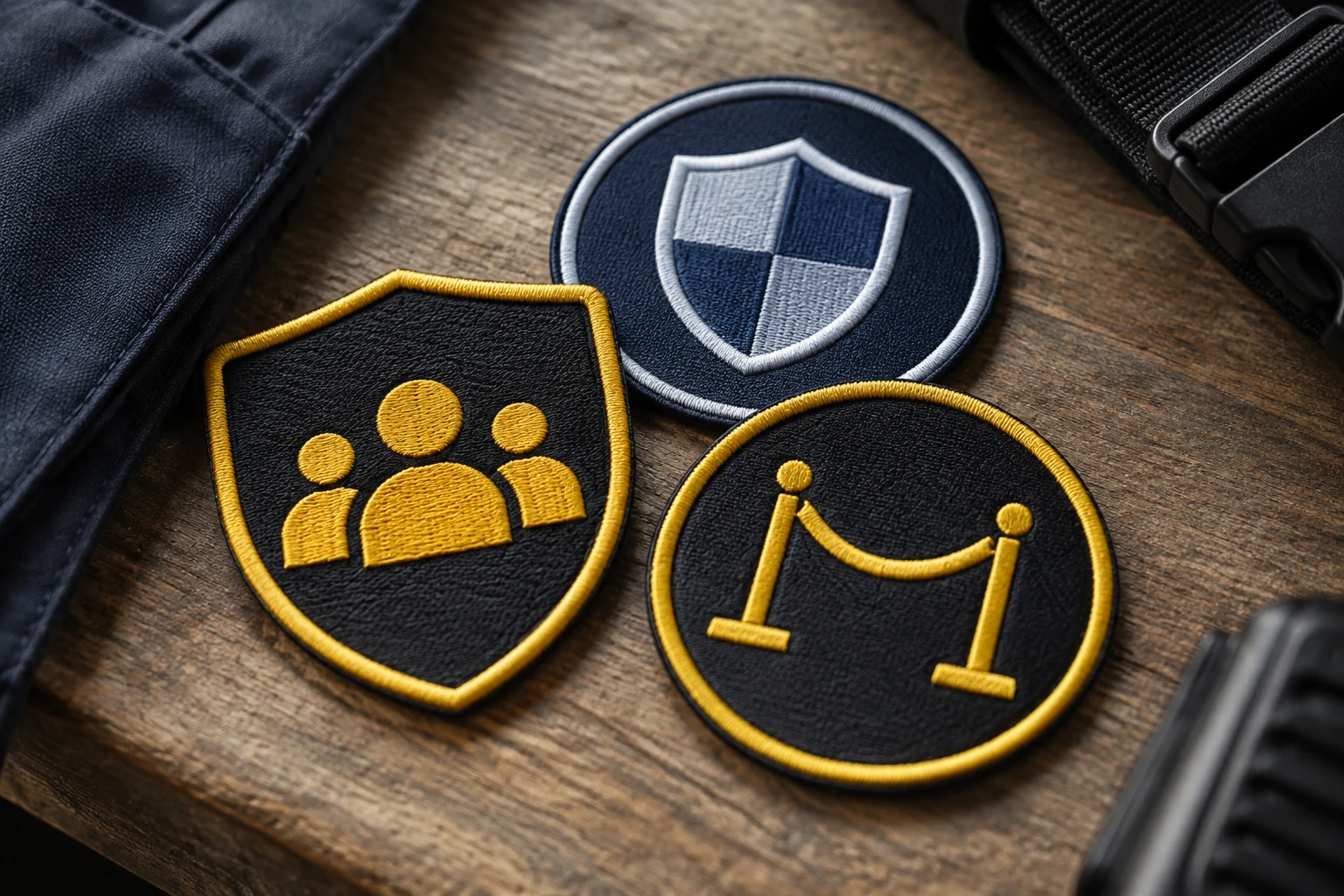
Security staff patches should make the wearer's role easy to read through bold lettering, strong contrast and visible placement. Keep SECURITY, STEWARD or EVENT STAFF larger than supporting details, and choose a backing that suits the uniform fabric.
A sleeve badge can identify a team at close range, but it offers less room for wording than a chest or back panel. Start with the role people need to recognise, then fit the organisation's branding around it.
What makes security staff patches readable?
Use a bold, uncomplicated typeface with open letter shapes. Narrow lettering, scripts and tightly packed capitals can lose definition in embroidery as stitches crowd small gaps, particularly inside letters such as R, B and A.
White on black or dark navy gives strong light–dark contrast. Yellow on black can also be clear, but ordinary coloured thread is not reflective and does not ensure visibility in darkness. Put colour behind a readable word rather than using colour alone to distinguish roles.
- Give the role one clear line where space permits; keep slogans off small sleeve badges.
- Leave visible space between letters and between the wording and the border.
- Use a contrasting border if a dark patch would disappear against a dark jacket.
- Check artwork at its finished size, not just enlarged on a screen.
What size and patch type should you specify?
There is no universal sleeve badge size: usable space changes with garment cut, seams and pockets. These dimensions are starting points for paper templates, not fixed standards or promises of reading distance.
| Position | Starting size: width × height | Design priority |
|---|---|---|
| Upper sleeve | 80 × 90 mm (3.1 × 3.5 inches) | Short role wording above or below a simple emblem; check sleeve curvature. |
| Chest role strip | 100 × 35 mm (3.9 × 1.4 inches) | One bold role word; leave breathing room around letters. |
| Back identification panel | 250 × 80 mm (9.8 × 3.1 inches) | Large role lettering; check that a hood or equipment will not cover it. |
Make the patch wider if lettering feels cramped rather than simply shrinking the text. A decorative shield may suit a sleeve emblem, while a rectangle gives long wording more usable space.
Send the role wording, intended dimensions and garment colour to compare the layout at scale. We provide a free digital mockup, usually within 12 hours.
GET A FREE MOCKUPEmbroidery, woven, printed or PVC?
Embroidered patches suit bold letters and simple crests, with a raised thread texture. Woven patches can retain finer lettering in a flatter construction, although text still needs to be large enough for a person to read.
Printed patches suit gradients and detailed artwork; PVC patches offer a moulded, wipe-clean face but can feel bulky on a lightweight polo. For identification, simplify the design before changing materials to preserve unnecessary detail.
Where should sleeve badges sit?
Place a paper template on the outer upper sleeve while someone wears the garment. Check it with the arm relaxed and bent: a badge that looks centred on a flat jacket can turn away from view once worn.
Agree one placement reference across the uniform range, such as the distance below the shoulder seam, then check each garment style. A set-in sleeve and a raglan sleeve do not provide the same reference point.
- Test the smallest garment size so the badge does not wrap too far around the arm.
- Keep clear of sleeve pockets, adjustment tabs and areas that fold repeatedly.
- Check visibility with radios, outer jackets and other equipment in place.
- Use chest or back wording as well if people need to identify the role from those directions.
Which backing suits the uniform fabric?
Sew-on patches are a practical permanent option for many polos, sweatshirts and uncoated jackets. Dense stitching and a heavy badge can pucker a thin polo, so check fabric support and patch weight. For heavier garments, see Patching Wool and Melton Jackets: Backings and Stitching That Work.
Do not assume iron-on backing is suitable for a nylon shell: application heat can damage the fabric or coating. Sewing through a waterproof shell can also compromise its weather resistance. Check the garment maker's instructions before choosing either attachment method.
Removable roles and washing
Hook-and-loop backing suits removable role labels, but the garment needs a compatible loop panel. Confirm which side is required and whether the matching panel is included in the quote; the patch backing alone does not create an attachment point.
Add the garment, backing and required arrival date to our [free mockup quote](#quote) form. Your free digital mockup is usually ready within 12 hours, with production starting only after approval.
GET A FREE MOCKUPIron-on adhesive may lift if bonding is poor or washing and drying exceed its care limits. Ask for care guidance for the finished patch and follow the most restrictive garment or patch instructions. Patch or Direct Embroidery on the Garment? When Each Makes Sense compares the alternatives if removable identification is unnecessary.
What should you send with the quote request?
The Customized Patches makes patches to order from your artwork, with a 5-piece minimum per design. Quotes start from £60, but the total depends on your specification; ask for the price against the exact quantity, dimensions and backing.
- Send artwork and exact role wording. List quantities separately for SECURITY, STEWARD and any other design.
- State finished width and height, patch type, colours and border preference.
- Name the garment fabric, patch position and backing; include a photograph if placement is uncertain.
- Give the delivery postcode and required arrival date. Ask for production and delivery timing before committing to an event.
- Check spelling, contrast, dimensions and backing on the mockup before approving production.
Our free digital mockup is usually ready within 12 hours; that is an artwork turnaround, not a manufacturing or delivery promise. We produce only after approval and offer free shipping across the United Kingdom. See Ordering Custom Patches for Northern Ireland, Scotland and Wales for further ordering guidance.
Frequently asked questions
What is the best material for security staff patches?
Embroidery suits bold role lettering and simple emblems. Woven construction suits finer detail, while PVC offers a wipe-clean face. Choose around readability, garment weight and care needs rather than appearance alone.
How small can embroidered lettering be?
There is no reliable minimum for every typeface and design. Letter width, spacing and stitch construction all matter. Ask for the wording to be assessed at the finished patch size.
Should SECURITY follow a curved badge edge?
A short, gently curved word can work, but a straight line usually leaves more room for consistent letter size and spacing. Avoid compressing the end letters to fit a shield.
Will a white embroidered patch show up in darkness?
White thread provides contrast where light is available; it is not inherently reflective. If low-light identification is required, discuss suitable materials separately rather than relying on thread colour.
Can different role labels share the 5-piece minimum?
The minimum is 5 pieces per design. Different role wording creates separate designs, so specify at least five SECURITY patches and five STEWARD patches if ordering both.
Does mockup approval mean the patches will arrive within 12 hours?
No. The free digital mockup is usually provided within 12 hours, and production begins only after approval. Confirm manufacturing and delivery timing against your event date before ordering.
Ready to produce custom patches for your UK team or brand?
GET A FREE MOCKUP